


Surgery may be an option for some patients with mesothelioma, depending on their cell type and whether doctors believe they can remove all visible tumors.
In cases of peritoneal mesothelioma, a combination of cytoreductive surgery with heated chemotherapy (HIPEC) is considered the gold standard of treatment, with some patients achieving long-term survival.
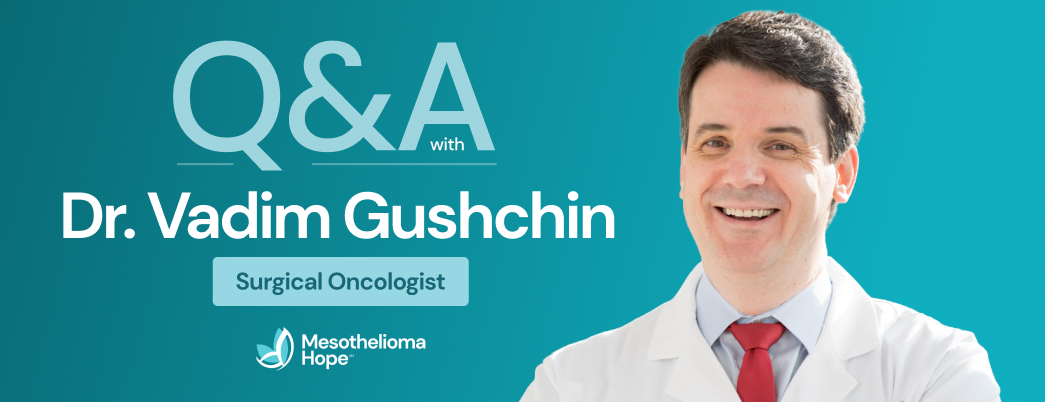
We recently spoke with Dr. Vadim Gushchin, who serves as the Director of Mercy Medical Center’s cytoreduction with HIPEC program in Baltimore, Maryland, about this treatment combination.
Dr. Gushchin explained the benefits of peritoneal mesothelioma surgery, when it’s most appropriate, side effects to watch out for, and more.
How do you decide if surgery is right for peritoneal mesothelioma patients?
To decide if a patient can undergo surgery, knowing the correct pathological diagnosis, or cell type, is critical. There are common distinctions between epithelial and sarcomatoid mesothelioma, and it’s important to make them.
Broadly, you should almost never operate on sarcomatoid mesothelioma because the surgeon has almost no chance against this disease. We have much better luck with epithelioid mesothelioma.
The other aspect is that it makes sense to do the surgery when you predict that complete removal of the tumor is possible. If you can’t do that, partial removal of the tumor is usually not helpful.
How do you prepare peritoneal mesothelioma patients for surgery?
The better patients are mentally, nutritionally, and physically going into mesothelioma surgery, the easier it is for them to recover from it.
I usually ask them to try and not lose weight, which includes not going on special diets that may lead to losing weight. Don’t slow down with physical activities. Don’t stay in bed. I pay attention to those aspects when working with patients who may qualify for surgery.
Peritoneal mesothelioma surgery is long, and the more surgical trauma patients sustain during the surgery — with good intentions, obviously — the more difficult it is for them to heal. So the stress of surgery is difficult for patients.
What would you suggest as first steps for patients considering surgery for peritoneal mesothelioma?
First, I would suggest that every patient with peritoneal mesothelioma should be referred to a place where cytoreductive surgery is done routinely.
The surgeon should make the determination whether complete cytoreduction is possible or not, and if surgery is even needed. More often than not, this is done by medical oncologists with the best intentions, but still, I think it is a surgeon’s job.
General surgical oncologists who don’t do peritoneal surface malignancy work may have a different outlook for these patients.
I would argue that early involvement of surgeons who deal with this disease on a regular basis should be the rule.
Finally, getting a second opinion is not a bad idea because for one surgeon, a tumor could be resectable, or able to be removed with surgery, while others may advise against it.
Could other treatments help peritoneal mesothelioma patients qualify for surgery?
From my perspective, pretreating patients so they become eligible for surgery is a good concept, but I don’t see that it works a lot of times.
The main option is systemic chemotherapy with various regimens. I think some centers try mesothelioma immunotherapy, too, with mixed results.
It’s kind of case by case, because this strategy may not work very well in all patients.
What are some side effects of cytoreduction with HIPEC?
The side effects of this treatment are related mostly to the surgery. For example, if patients had removal of part of the intestine, colon, or stomach, they may be prone to developing gastrointestinal-related symptoms.
They have difficulty eating. If you remove too much small bowel, they may have diarrhea and lose weight this way, or become dehydrated.
HIPEC doesn’t make these side effects better. It’s not like some sort of vitamin infusion. It just aggravates the side effects. So the nausea tends to be a little bit longer and diarrhea a little bit more persistent. I would estimate it adds about 10% to the severity of all these side effects.
The important thing to know is that patients start feeling normal probably about two months after cytoreductive surgery. They tend to have dealt with most of the side effects by six months after the surgery. They tend to have put everything behind them and forget about the surgery, more or less, in their everyday activities after a year.
How do you help patients with mesothelioma understand their prognosis and stay hopeful?
So we, as doctors, have scientific definitions of prognosis, including terms like disease-free survival and progression-free survival.
If patients have a complete surgical resection, they tend to have more favorable outcomes. Some live beyond five to six years, which is very good, I think, in terms of this disease’s prognosis.
Patients who did not get into surgery or who have unfavorable histology may not have a very good prognosis. The cancer usually progresses within a year or two on systemic therapy. So prognosis really depends on what histology they have, what treatment they have, and what the result of their treatment was.
I usually ask the patients first what they mean by prognosis. For different patients, prognosis means different things. I usually say, “Well, what do you want to do in the next several years?” One patient wanted to go back to Alaska, where he grew up, and still be able to hunt and fish. With treatment, he was able to do that.
I also want to touch on hope. I did my residency together with Dr. David Sugarbaker. He was at the Washington Hospital Center and pioneered the surgical approach in treating patients with peritoneal disease. I was exposed to big miracles he was doing with patients who nobody wanted to treat, and nobody knew how to treat, 25 years ago.
Connect With Top Peritoneal Mesothelioma Doctors
Cytoreductive surgery with HIPEC is a benchmark treatment in helping extend survival for peritoneal mesothelioma patients, allowing doctors to destroy as much of the cancer as possible.
When patients are under the care of mesothelioma specialists like Dr. Gushchin, they can get a better understanding of how surgeries and other treatments could improve their health outcomes.
At Mesothelioma Hope, our team is ready to help patients and families facing this rare cancer find top doctors, explore treatment plans, and move forward.
Call (866) 608-8933 or contact us now to learn more about how we can assist you.