
What Is Stage 1 Mesothelioma?
Stage 1 mesothelioma is the earliest form of the disease. Doctors use the four mesothelioma stages to describe how far the cancer has spread.
In stage 1 of mesothelioma, tumors are still small and limited to one area of the body and haven’t reached the lymph nodes (small glands that help the body fight infection).
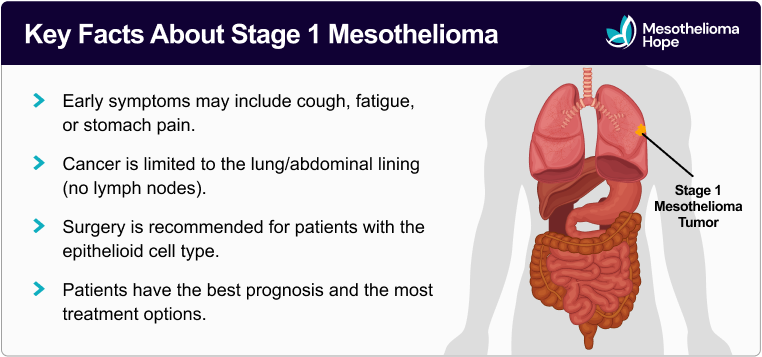
The most common type of mesothelioma is pleural mesothelioma, which starts in the thin lining around the lungs and chest cavity (the pleura). The second most common type is peritoneal mesothelioma, which affects the abdominal lining (peritoneum).
Get our Free Mesothelioma Guide to learn more about stage 1 mesothelioma and the treatments doctors recommend to improve survival and quality of life.
How Stage 1 Mesothelioma Develops
All stages of mesothelioma begin 10-50 years after a person is exposed to asbestos. Asbestos is a mineral once widely used in construction and many everyday products to make them fireproof and heat-resistant. When asbestos materials are damaged or disturbed, tiny fibers can break loose and become airborne.
If you breathe in or swallow asbestos fibers, they can travel deep into your body. Some of them may become stuck in the thin lining that covers your lungs, abdomen, or other organs. Once the fibers get lodged in these delicate tissues, your body cannot easily remove them.
Over time, the trapped fibers cause irritation and long-lasting inflammation in the surrounding tissue. This constant irritation can harm the DNA inside nearby cells. When their DNA is damaged, cells may begin growing out of control and eventually form cancerous tumors.
Stage 1 Mesothelioma Symptoms
At this stage, the cancer may not cause noticeable health issues. In fact, some people have no symptoms at all in mesothelioma stage 1, which is one reason why delayed diagnosis is so common.
When early-stage symptoms do appear, they are usually mild and can be mistaken for common illnesses like a chest infection, upset stomach, or the flu. Even though stage 1 mesothelioma symptoms can be subtle, make sure you stay alert to changes in your health. If you notice any of the signs listed below and they don’t go away, let your doctor know so they can investigate further.
Possible Symptoms by Mesothelioma Type
Pleural Mesothelioma (lungs and chest):
- Fatigue or low energy
- Loss of appetite
- Mild chest pain
- Persistent cough
- Shortness of breath, especially during physical activity
While pleural mesothelioma symptoms mainly affect the lungs and chest, peritoneal mesothelioma impacts the abdominal area. Patients may experience a different set of early warning signs, which can sometimes be mistaken for common digestive issues.
Peritoneal Mesothelioma (abdomen):
- Abdominal pain or cramping
- Bloating or swelling in the belly
- Changes in bowel habits (constipation or diarrhea)
- Fatigue or low energy
- Loss of appetite
Because these symptoms are often subtle or mistaken for minor stomach problems, stage 1 peritoneal mesothelioma can easily go undetected without specialized testing.
Diagnosis Process for Stage 1 Mesothelioma
Most specialists follow a step-by-step process to diagnose mesothelioma. Each step helps rule out other conditions and gets you closer to an accurate diagnosis.
- Physical exam: The doctor will start by listening to your chest, feeling your abdomen, and checking for any unusual swelling, fluid buildup, or breathing changes.
- Imaging scans: If something looks concerning, the next step is usually an X-ray, CT scan, or MRI. These scans may reveal fluid around the lungs or unusual tissue growths that could be linked to mesothelioma.
- Biopsy: Your doctor will take a small sample of tissue or fluid and look at it under a microscope. They’ll then use your scans and biopsy results to determine the stage of the cancer and your mesothelioma cell type (epithelioid, sarcomatoid, or biphasic).
When doctors confirm that a patient has mesothelioma, they use the tumor-node-metastasis (TNM) system to determine the stage of the disease. If the cancer is limited to the lining of the lungs or abdomen and hasn’t spread elsewhere, it’s classified as stage 1 mesothelioma.
Download our Free Questions to Ask Your Doctor Checklist to ensure you feel confident about your diagnosis and next steps.

Stage 1 Mesothelioma Treatment
The goal of treating stage 1 mesothelioma is to remove or control the cancer early so it has less chance of spreading. The specific mesothelioma treatments used depend on the cell type of the cancer, where it’s located, and your overall health.
Surgery
Doctors may recommend surgery for some patients with stage 1 mesothelioma, but usually only if the cancer is the epithelioid cell type. This type tends to respond better to surgery compared to the sarcomatoid and biphasic cell types.
The main surgeries used for stage 1 mesothelioma are:
- Pleurectomy with decortication
- Extrapleural pneumectomy
- Cytoreduction with heated chemotherapy (HIPEC)
Surgery isn’t right for everyone, but it can be a strong first step in treating stage 1 mesothelioma. Many treatment plans also include chemotherapy and/or immunotherapy to reduce the risk of the cancer coming back.

“When it’s only in one location — where the cancer started — and hasn’t spread anywhere else, we look at what we can do to get the best outcomes. For lung cancer and mesothelioma, that sometimes includes surgery.”
Chemotherapy and Immunotherapy
Even after surgery, tiny cancer cells that doctors can’t detect may still remain in the body. To reduce the risk of mesothelioma coming back or spreading, doctors often prescribe medicines that travel throughout the body to destroy cancer cells. These are called systemic therapies.
- Chemotherapy uses drugs that directly attack and kill fast-growing cancer cells. For mesothelioma, the most common mix is two drugs (pemetrexed with either cisplatin or carboplatin). This approach is used most often for the epithelioid cell type.
- Immunotherapy is a newer treatment that helps the immune system find and destroy cancer cells. In 2026, experts recommend immunotherapy as the main treatment for people with the sarcomatoid or biphasic cell types. For patients who have the epithelioid type, chemotherapy is usually tried first, and immunotherapy may be added later if needed.
Your doctor will explain whether chemotherapy, immunotherapy, or a mix of both is the best fit based on the type of mesothelioma you have and your overall health.
Radiation Therapy
Radiation therapy uses high-energy beams to kill cancer cells in a specific area. For stage 1 mesothelioma, doctors may use radiation after surgery to target any cancer cells left behind. This can help prevent the cancer from coming back where it first started.
Radiation isn’t usually used alone to treat mesothelioma, but it can be an important piece of a patient’s care plan. In some cases, radiation is also used palliatively to ease symptoms like pain or shortness of breath.
Connect with a specialist through our Free Doctor Match to get personalized treatment options for stage 1 mesothelioma.

Stage 1 Mesothelioma Prognosis
A mesothelioma prognosis is how doctors expect the disease to progress over time. Patients diagnosed in stage 1 usually have the best prognosis because the cancer hasn’t spread beyond the chest wall or abdomen and may be able to be removed with surgery.
On average, patients with stage 1 pleural mesothelioma live about 21 months. For stage 1 peritoneal mesothelioma, the prognosis is 4–5 years when patients undergo cytoreductive surgery with heated chemotherapy (HIPEC).
Stage 1 Mesothelioma Survival Rates
Mesothelioma survival rates are a way of showing how long patients live after diagnosis. It tells you the percentage of people still alive at a certain point in time, such as 1 year or 5 years. For example, a 5-year survival rate of 20% means that 20 out of 100 patients were alive 5 years after their diagnosis.
The table below shows survival rates for stage 1 mesothelioma, comparing all patients to those who received specialized care and surgery.
| Stage 1 Mesothelioma Type & Treatment | 1-Year Survival Rate | 5-Year Survival Rate |
|---|---|---|
| Pleural (all patients) | 41% | 6% |
| Pleural (with treatment) | 60-70% | 10-16% |
| Peritoneal (all patients) | 74% | 26% |
| Peritoneal (with treatment) | 80-90% | 47-52% |
Sources: SEER (2015–2021), American Cancer Society, peer-reviewed studies (2023, 2025)
Get Support for Stage 1 Mesothelioma
An early-stage mesothelioma diagnosis offers more opportunities for treatment and better outcomes. Mesothelioma Hope is here to guide you through the next steps so you can make more informed decisions about your health.
If you have stage 1 mesothelioma, our team can help you:
- Review your pathology report and fully understand your diagnosis
- Explore treatments that may help you live longer
- Find financial assistance to cover treatment and daily expenses
- Access support resources for you and your family
Call us now at (866) 608-8933 or use our Free Doctor Match to find local mesothelioma doctors who specialize in treating stage 1 patients.
Mesothelioma Stage 1 FAQs
What does early mesothelioma feel like?
In mesothelioma stage 1, the cancer is contained to one side of the chest or abdomen. Because it hasn’t spread very far, many people have little to no symptoms at this point.
When symptoms do appear, they may include mild chest or abdominal pain, shortness of breath, coughing, fatigue, or unexplained weight loss. These signs are often mistaken for more common illnesses, which is why mesothelioma is so hard to detect early.
How do you treat stage 1 mesothelioma?
Stage 1 mesothelioma patients usually have the most options because the cancer hasn’t spread much, if at all. According to 2025 guidelines, treatment depends on your overall health, cell type, and whether lymph nodes are involved.
- Surgery may be an option for some patients. For pleural mesothelioma, this usually means a pleurectomy/decortication, where doctors remove the lining of the lung and visible tumors but keep the lung itself. For peritoneal mesothelioma, a cytoreduction may be done to take out as much cancer as possible.
- Chemotherapy with pemetrexed plus a platinum drug remains a standard treatment and is often used to help shrink or control tumors.
- Immunotherapy is now an option, especially for patients with sarcomatoid or biphasic cell types. In some cases, it may also be combined with chemotherapy.
- Radiation therapy isn’t routine but may be used after surgery to help target any remaining cancer cells.
Patients with stage 1 cancer should see a mesothelioma specialist to build a treatment plan tailored to their diagnosis.
What is the prognosis for stage 1 mesothelioma?
Prognosis refers to how doctors expect the cancer to progress over time. Mesothelioma patients diagnosed at stage 1 generally live longer than those diagnosed at later stages because the disease is less advanced and more treatable.
On average, 45% of patients are alive 2 years after diagnosis, and about 16% live at least 5 years. Some patients have lived well beyond these averages, especially those who undergo surgery combined with other treatments. Every case is unique, and outcomes depend on factors like overall health, age, and the type of mesothelioma.
Is stage 1 mesothelioma curable?
There isn’t a cure for mesothelioma yet, even in the earliest stage. However, treatment at stage 1 can significantly slow the cancer’s growth, control symptoms, and extend life expectancy. Many patients are able to live longer, fuller lives when they receive care from specialists who know how to treat this rare cancer.
Can you treat mesothelioma if caught early?
Even when caught early, mesothelioma cannot be fully cured with today’s treatments. That said, stage 1 mesothelioma patients may respond better to surgery and other therapies compared to those diagnosed in the later stages.
Researchers continue to study emerging treatments like targeted therapy, vaccines, and chemoimmunotherapy in hopes of improving survival and eventually finding a cure.




 How We Can Help