
What Is the Mesothelioma Statute of Limitations?
The mesothelioma statute of limitations is the legal deadline for filing a lawsuit to seek financial compensation from the companies responsible for your asbestos exposure.
Because mesothelioma can take 10 to 50 years to develop, the statute of limitations doesn’t begin at the time of asbestos exposure. Instead, the deadline usually starts on the date of diagnosis for patients or on the date of death for surviving family members.
Every state has its own statute of limitations on asbestos claims that determines how much time you have to take legal action. Because these deadlines can be surprisingly short (sometimes as little as 1 year), it’s crucial to talk to a mesothelioma lawyer right away so you don’t miss your chance to file a claim.

“Every state has its own statute of limitations that decides how much time clients have to take legal action. In many states, the deadline to file is only 1 to 3 years after a diagnosis.”
The laws regarding the mesothelioma claims time limit depend on where you live and where you were exposed to asbestos.
Our partner mesothelioma attorneys specialize in these rules and can determine the exact deadline that applies to your situation. Get a Free Case Review to see if you can file a claim before the deadline expires.
 Get a Free Mesothelioma Case Review


Mesothelioma Statute of Limitations by State
The mesothelioma statute of limitations varies based on the state where you file your asbestos lawsuit. The table below shows the time limits for personal injury lawsuits and wrongful death claims in each state.
| State | Statute After a Mesothelioma Diagnosis | Statute After the Death of a Loved One |
|---|---|---|
| Alabama | 2 years after diagnosis | 2 years after death |
| Alaska | 2 years after diagnosis | 2 years after death |
| Arizona | 2 years after diagnosis | 2 years after death |
| Arkansas | 3 years after diagnosis | 3 years after death |
| California | 1 year after diagnosis | 1 year after death |
| Colorado | 2 years after diagnosis | 2 years after death |
| Connecticut | 3 years after diagnosis | 3 years after death |
| Delaware | 2 years after diagnosis | 2 years after death |
| Florida | 2 years after diagnosis | 2 years after death |
| Georgia | 2 years after diagnosis | 2 years after death |
| Hawaii | 2 years after diagnosis | 2 years after death |
| Idaho | 2 years after diagnosis | 2 years after death |
| Illinois | 2 years after diagnosis | 2 years after death |
| Indiana | 2 years after diagnosis | 2 years after death |
| Iowa | 2 years after diagnosis | 2 years after death |
| Kansas | 2 years after diagnosis | 2 years after death |
| Kentucky | 1 year after diagnosis | 1 year after death |
| Louisiana | 2 years after diagnosis | 1 year after death |
| Maine | 6 years after diagnosis | 2 years after death |
| Maryland | 3 years after diagnosis | 3 years after death |
| Massachusetts | 3 years after diagnosis | 3 years after death |
| Michigan | 3 years after diagnosis | 3 years after death |
| Minnesota | 6 years after diagnosis | 3 years after death |
| Mississippi | 3 years after diagnosis | 3 years after death |
| Missouri | 5 years after diagnosis | 3 years after death |
| Montana | 3 years after diagnosis | 3 years after death |
| Nebraska | 4 years after diagnosis | 2 years after death |
| Nevada | 2 years after diagnosis | 2 years after death |
| New Hampshire | 3 years after diagnosis | 3 years after death |
| New Jersey | 2 years after diagnosis | 2 years after death |
| New Mexico | 3 years after diagnosis | 3 years after death |
| New York | 3 years after diagnosis | 2 years after death |
| North Carolina | 3 years after diagnosis | 2 years after death |
| North Dakota | 6 years after diagnosis | 2 years after death |
| Ohio | 2 years after diagnosis | 2 years after death |
| Oklahoma | 2 years after diagnosis | 2 years after death |
| Oregon | 2 years after diagnosis | 3 years after death |
| Pennsylvania | 2 years after diagnosis | 2 years after death |
| Rhode Island | 3 years after diagnosis | 3 years after death |
| South Carolina | 3 years after diagnosis | 3 years after death |
| South Dakota | 3 years after diagnosis | 3 years after death |
| Tennessee | 1 year after diagnosis | 1 year after death |
| Texas | 2 years after diagnosis | 2 years after death |
| Utah | 3 years after diagnosis | 2 years after death |
| Vermont | 3 years after diagnosis | 2 years after death |
| Virginia | 2 years after diagnosis | 2 years after death |
| Washington | 3 years after diagnosis | 3 years after death |
| West Virginia | 2 years after diagnosis | 2 years after death |
| Wisconsin | 3 years after diagnosis | 3 years after death |
| Wyoming | 4 years after diagnosis | 2 years after death |
The statute of limitations that applies to your specific case may not be the same as in your current state. Rather, it can be determined by the state where you were exposed to asbestos or where you lived at the time of exposure, not just where you live now.
Many families have multiple options for where to file, and choosing the right place can make a big difference. Get a Free Case Review with our legal partners at Simmons Hanly Conroy to confirm your state’s deadline and preserve your right to compensation.
Top 3 Reasons to File a Mesothelioma Claim Early
A mesothelioma diagnosis is life-changing, and the thought of legal action can feel overwhelming. However, filing a lawsuit is a critical step you can take right now to regain a sense of control over your financial future and protect your family’s well-being.
1. Accessing Funds for Treatment
A mesothelioma diagnosis can bring a lot of financial strain. Pursuing compensation early can help you get funds to afford treatment costs and ease the financial stress that your family is facing right now.
Mesothelioma treatment often requires specialized surgeries and new therapies, which can be extremely expensive. Advanced care can easily cost over $400,000, especially when you need to travel to see expert doctors.
Starting the legal process early allows your attorney to quickly file claims against the asbestos companies responsible for your illness. Compensation from these claims can cover transportation, lodging, and flights needed to access top specialists if they aren’t available in your area. It also prevents you from having to drain your savings or take out personal loans to pay for medical care and daily living expenses.

“If we had waited until later, we would’ve missed out on the opportunity to get him the help that he’s getting now.”
2. Preserving Evidence While It’s Available
The longer you wait, the harder it becomes to track down the critical evidence needed to build a strong mesothelioma case and prove which companies were responsible. Filing early allows your mesothelioma lawyer to act quickly while key evidence is still intact.
Your legal team must act fast to gather:
- Workplace documentation: Mesothelioma lawyers can quickly investigate and secure essential records like purchase orders, production logs, and equipment maintenance schedules to pinpoint the exact asbestos-containing products used at your former work sites.
- Military service records: For veterans with mesothelioma, prompt filing allows your attorney to access official service records, like your DD-214 form and duty rosters, to determine exposure locations.
- Union information: Your lawyer can use union records to identify specific job sites and access industry-specific details that are needed for proving your asbestos exposure.
- Witness statements: Your memory and the memories of former coworkers or family are freshest right after diagnosis and before starting treatment. Due to the potential effects of chemo brain, filing your claim promptly ensures your memory is reliable.
By acting sooner rather than later, you can ensure your legal team has access to the freshest information, strengthening your overall claim.
3. Protecting Your Family’s Financial Future
A mesothelioma claim can make a life-changing difference for your family. Compensation can help cover medical bills, lost wages, in-home care, travel for treatment, and other costs that add up quickly. It can also provide payment for pain and suffering, which recognizes the emotional and physical toll of the disease.
More importantly, a successful claim can give your family long-term financial stability. Many families use this compensation to pay off debt, secure housing, support children or grandchildren, or cover daily expenses after a loved one can no longer work.

“To know that when you’re gone, they’re going to be taken care of, whether they’re children or they’re adults. It’s nice to know there’s something there for them.”
Taking action can also create a sense of peace. In fact, over 65% of mesothelioma patients decide to take legal action to keep their loved ones financially secure, according to the journal Palliative Medicine. Knowing your family will have financial support can reduce stress and bring comfort to you and the people you care about most.
Download our Free Attorney Checklist to learn which questions to ask about filing a claim and how to find the right legal team for your case.

Where Should I File My Asbestos Claim?
Choosing the right place to file your mesothelioma claim is important. Every state has its own laws, timelines, and history with asbestos cases, which means the location can affect how fast your claim moves and how much compensation you may receive. Your legal team will review several key factors to determine the strongest place to file.
These may include:
- Where you worked at the time of exposure
- Where the asbestos companies operated or sold their products
- Where your military service took place, if relevant
- Where company records and evidence are located
- Which states have a history of fair results in asbestos cases
In many situations, you are not limited to filing a claim in the state where you currently live. You may qualify to file in multiple states, and your attorneys will select the location that gives you the best chance for a successful outcome.
Factors Affecting the Mesothelioma Claims Time Limit
Every state sets its own statute of limitations, which means the amount of time you have to file a mesothelioma claim depends on where and how your case is filed.
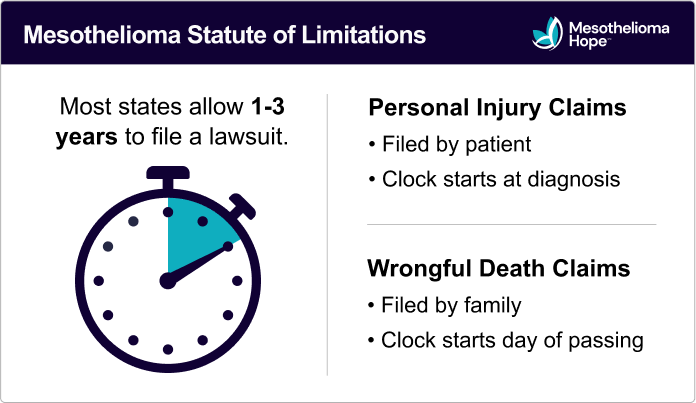
Understanding the key factors that influence the mesothelioma claims time limit can help you avoid missing your chance to secure compensation for your family.
Diagnosis Date
In most cases, the statute of limitations on mesothelioma claims begins on the day a doctor confirms your diagnosis. Attorneys rely on medical records such as pathology reports, imaging scans, and physician notes to verify this date.
These documents establish a clear timeline and help ensure your claim is filed within the proper window. Because this date is so important, attorneys review it carefully when preparing your case.
Date of Death in Wrongful Death Cases
If you are filing a claim on behalf of a loved one who passed away, the mesothelioma claims time limit works differently. The filing period usually starts on the date of death rather than the date of diagnosis.
Spouses, children, mesothelioma caregivers, and other eligible family members or estate representatives may have the right to file a wrongful death claim.
Differences Between States
One of the biggest factors affecting your filing deadline is the state where your claim is filed. Some states allow only 1 year to file a mesothelioma lawsuit, while others provide 2 to 3 years or more.
Your attorney will review your work history, where the exposure occurred, and where the responsible companies operated to determine which state’s laws apply.
Military Veterans
Many veterans were exposed to asbestos during their service, and they often have more than one way to file for compensation. Veterans may qualify for VA benefits, lawsuit settlements against the companies that made asbestos products, and asbestos trust fund claims.
Each of these options has its own rules and deadlines. Attorneys review service records, job roles, and duty locations to determine where exposure most likely occurred and which claims are available.
Asbestos Trust Fund Deadlines
Many asbestos companies filed for bankruptcy and created trust funds to compensate victims. Asbestos trust funds have their own deadlines that aren’t subject to state statutes of limitations. Each trust sets its own rules based on the company, the type of exposure, and the nature of the claim.
Attorneys can determine which trusts you qualify for and file claims with each of them. Trust fund deadlines can sometimes offer an additional opportunity to receive compensation, even if your time to file a lawsuit has passed.
What if the Mesothelioma Statute of Limitations Has Run Out?
Even if you think it’s too late to file, you may still have options. Our legal partners at mesothelioma law firm Simmons Hanly Conroy can review your history and determine whether additional pathways to compensation still exist.
Some of these may include:
- Asbestos Trust Funds
Over $30 billion is available in trusts created by bankrupt asbestos companies. These funds have their own deadlines that are separate from state statutes, which may give you extra time. - Filing in Another State
Depending on where you lived, worked, or were exposed, you may be eligible to file in a different state with a longer time limit. - VA Benefits
Veterans may qualify for disability compensation from the U.S. Department of Veterans Affairs (VA), which can provide $4,158.17 per month in tax-free benefits. - Extensions or Exceptions
Certain rare situations may qualify for deadline extensions, depending on state law.
Even if you think your deadline has passed, you may still be able to recover compensation for your family. Get a Free Case Review so our legal partners can check for you.
Get Help Filing Your Mesothelioma Claim in Time
Filing a mesothelioma claim is time-sensitive, and many families feel unsure about what to do first. You don’t need to navigate this on your own. Mesothelioma Hope and Simmons Hanly Conroy can guide you through every stage of the process so you can focus on your health and your family.
Our legal partners are here to:
- Confirm your eligibility and file your claim before the deadline
- Identify the companies and products that exposed you to asbestos
- Collect medical records, work history, and other evidence needed for your case
- Provide expert legal help with no travel required and no upfront costs
If you believe you may have a claim, now is the best time to get answers. Call (866) 608-8933 to speak with us and start your free case review.
Mesothelioma Statutes of Limitations FAQs
What is the statute of limitations on mesothelioma?
The statute of limitations is the legal time limit you have to file a mesothelioma claim. This rule exists in every state, and the deadline is usually between 1-3 years.
Because mesothelioma is often diagnosed at a later stage, these time limits are designed to give patients and families a fair chance to take action.
If you or a loved one was recently diagnosed, it is important to speak with an attorney as soon as you feel ready. Acting early helps protect your right to compensation and gives your legal team more time to build a strong case.
When does the statute of limitations start for a mesothelioma claim?
For most patients, the timeline begins on the day a doctor confirms the mesothelioma diagnosis. This date is recorded in medical files and helps determine when the legal deadline will expire.
If you recently lost a loved one to mesothelioma, the time limit for filing an asbestos claim after death usually starts on the date of their passing. This can feel overwhelming during a period of grief, which is why many families choose to work with an attorney who can guide them through each step.
If you need help understanding your deadlines or exploring your options, contact our team today to get the support you deserve.
What happens if I miss the mesothelioma claim time limit?
If the deadline has passed, you may no longer be able to file a lawsuit in that state. However, it doesn’t always mean you are out of options. You may still qualify to file in another state, depending on where the exposure happened or where the responsible asbestos companies were located.
You may also be able to file asbestos trust fund claims, which have their own deadlines and may offer additional time. Additionally, U.S. military veterans with mesothelioma may qualify for VA benefits.
A mesothelioma attorney can review your situation and let you know if any of these options are still available.
What is the statute of limitations on asbestos claims?
Asbestos claims follow the same general rules as those for mesothelioma claims. The deadline usually starts when someone is diagnosed with an asbestos-related disease, such as mesothelioma, lung cancer, or asbestosis. If a loved one passed away, the timeline typically begins on the date of death.
Because each state sets its own rules, the time limit can vary. Speaking with an attorney early helps you understand your specific deadline and prevents you from missing an important opportunity to pursue compensation.
Get a Free Case Review for help understanding your options. Our experienced legal team can guide you through the next steps and explain your filing timeline.
Can the mesothelioma statute of limitations be extended?
Extensions are possible, but they aren’t very common. Some states allow extra time in special situations, such as when new information about exposure comes to light. These exceptions depend on state law and the details of your case.
Even if you believe your deadline has passed, it’s still worth speaking with an attorney. They can carefully review your situation, determine whether an extension might apply, and check if you qualify for other options like asbestos trust fund claims or veterans benefits.
Many families are surprised to learn they still have more opportunities to pursue compensation than they originally thought.








 How We Can Help