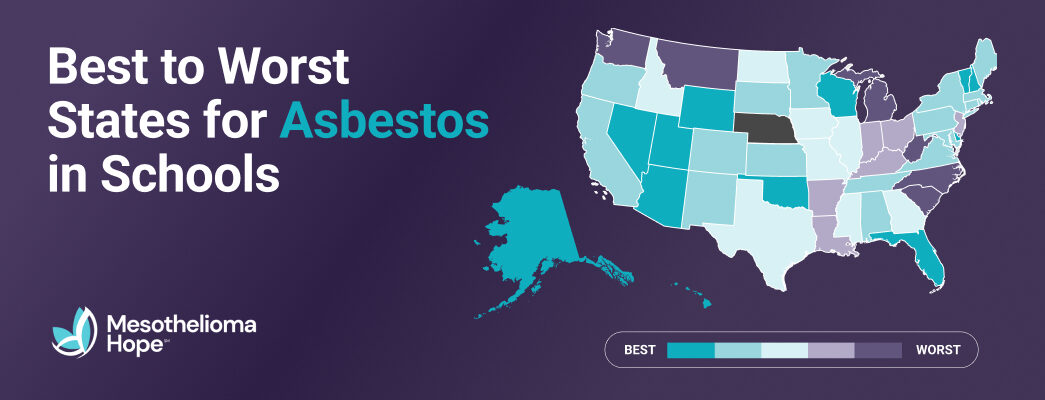


Asbestos is still present in thousands of American schools in all 50 states, putting students and staff at risk of a rare cancer called mesothelioma. A new analysis of federal enforcement data reveals stark differences between states when it comes to preventing exposure to asbestos in schools. Learn how your state ranks and how to stay safe.
Key Stats on Asbestos in Schools
- Alaska
- Arizona
- Delaware
- Florida
- Hawaii
- Washington
- West Virginia
- North Carolina
- Montana
- South Carolina
The Rankings: All 50 States Rated for Asbestos in Schools
Mesothelioma Hope examined violations related to asbestos exposure and compliance histories in public schools for all 50 states. This was done using the Environmental Protection Agency’s Enforcement and Compliance History Online (ECHO) database, which contains records for 5,217 schools across the country.
We used two data points to rank asbestos exposure in schools :
- First, each school facility was scored based on its ECHO compliance record, including Significant Non-Compliance flags, time out of compliance, enforcement actions, and inspections. These factors reflect how well asbestos risks are managed.
- Next, we calculated a state score by averaging the scores of all facilities within that state rather than using a total, so larger states weren’t penalized. Lower scores indicate safer conditions, and each state was assigned a letter grade from A to F based on its average score.
Asbestos Safety in Public Schools: Verified State Grades
- Grade A - No Violations
- Grade B - Minor Violations
- Grade C - Moderate Violations
- Grade D - Significant Violations
- Grade F - Most At-Risk
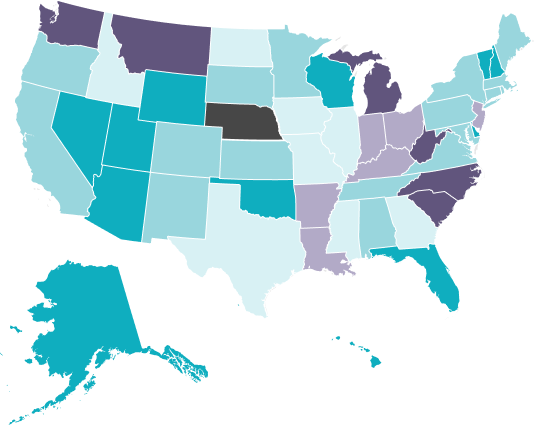
(5,217 facilities; average score per facility)

The full ranking
Rank & Average Score Per Facility
0 (Excellent) - 17.85 (Most At-Risk)
- 1Alaska0
- 1Arizona0
- 1Delaware0
- 1Florida0
- 1Hawaii0
- 1Nevada0
- 1New Hampshire0
- 1Rhode Island0
- 1Utah0
- 1Vermont0
- 1Wisconsin0
- 1Wyoming0
- 13Massachusetts0.144
- 14Virginia0.219
- 15New York0.263
- 16Maryland0.32
- 17Connecticut0.328
- 18Kansas0.421
- 19Nebraska0.5
- 20California0.5
- 21Oregon0.509
- 22Minnesota0.583
- 23New Mexico0.616
- 24South Dakota0.856
- 25Colorado1.193
- 26Alabama1.242
- 27Maine1.425
- 28Tennessee1.44
- 29Pennsylvania1.461
- 30Mississippi2.703
- 31Texas2.733
- 32North Dakota2.986
- 33Georgia3.034
- 34Illinois3.045
- 35Idaho3.3
- 36Iowa3.451
- 37Missouri3.611
- 38Indiana4.257
- 39Kentucky5.095
- 40Arkansas5.728
- 41New Jersey5.851
- 42Louisiana6.26
- 43Ohio6.527
- 44Washington D.C.8
- 45Michigan8.809
- 46South Carolina9.029
- 47Montana10.4
- 48North Carolina12.894
- 49West Virginia14.541
- 50Washington17.85
*Note: Oklahoma is excluded from this ranking due to the absence of facility-level data in the EPA ECHO database.
Twelve states achieved an A grade. They included smaller, less densely populated states such as Wyoming and Vermont, as well as larger states like Florida and Arizona. They show that asbestos in schools can be managed to keep students and teachers safe from diseases like mesothelioma later in life.
Fourteen states, as well as Washington, D.C., received a D or F grade. These states had consistent or repeated issues with asbestos in schools. If you live in these states, look into your child’s school to learn what’s being done to manage asbestos.
Top 5 Worst States for Asbestos Exposure in Schools
The 5 worst states in our analysis were Montana, North Carolina, South Carolina, Washington, and West Virginia. These states recorded the highest average per-facility scores, driven by prolonged non-compliance, Significant Non-Compliance (SNC) designations, and formal enforcement actions.
- #1 Alaska0.000
- #1 Arizona0.000
- #1 Delaware0.000
- #1 Florida0.000
- #1 Hawaii0.000
- #50 Washington17.850
- #49 West Virginia14.541
- #48 North Carolina12.894
- #47 Montana10.400
- #46 South Carolina9.029
Washington
- Highest Risk in Country
- Severe Non-Compliance
Washington ranks as the worst state overall. A relatively small number of facilities drive its score, each with severe, long-running violations that persisted for years without remediation, rather than widespread issues across the state.
Seattle Public Schools has faced scrutiny over delayed asbestos repairs and ongoing maintenance issues in older buildings, highlighting how concentrated problems can still create serious risks.
West Virginia
- Highest Risk in Country
- Severe Non-Compliance
West Virginia shows a more widespread pattern of problems. The state has some of the oldest school buildings in the country and limited capital spending, which has led to long periods of unresolved compliance issues across many facilities.
A 2024 lawsuit involving Fairmont State University brought renewed attention to asbestos exposure risks, with a former student alleging that exposure in aging buildings led to their mesothelioma diagnosis.
North Carolina
- Highest Risk in Country
- Severe Non-Compliance
North Carolina ranks among the worst-performing states and has acknowledged the scale of the problem. State officials launched a large inspection effort covering 3,100 schools and 5,700 childcare centers as part of a $26 million EPA initiative that began in 2023.
Districts like Charlotte-Mecklenburg Schools continue to face challenges tied to aging buildings and environmental safety, reflecting the scope of the statewide effort.
Montana
- Highest Risk in Country
- Severe Non-Compliance
Montana ranks among the worst states in part because of its industrial past and ongoing environmental challenges tied to asbestos.
The town of Libby was the site of one of the most severe asbestos contamination events in U.S. history, and its effects still impact the region today.
South Carolina
- Highest Risk in Country
- Severe Non-Compliance
South Carolina rounds out the bottom group, with older school buildings, limited funding for upgrades, and a compliance record that includes multiple enforcement actions across its school systems.
Districts such as Richland School District One continue to deal with aging infrastructure and maintenance backlogs.
Top 5 Best States for Asbestos Exposure in Schools
The top 5 safest states for asbestos exposure in schools were Alaska, Arizona, Delaware, Florida, and Hawaii. These states had minimal issues with asbestos in schools, with little to no citations or violations.
Alaska
- No Violations Recorded
- Zero Enforcement Actions
Alaska ranks among the best states in part due to its geographic isolation. Historically, this limited the amount of asbestos-containing materials used in construction, since building materials had to be shipped long distances.
Arizona
- No Violations Recorded
- Zero Enforcement Actions
Arizona ranks among the best largely because much of its school construction occurred after asbestos use declined in the 1980s. As a result, many buildings are newer and contain fewer asbestos materials to manage.
Delaware
- No Violations Recorded
- Zero Enforcement Actions
Delaware stands out for consistent compliance across its school facilities. Its smaller size likely allows for more centralized oversight and fewer total buildings to manage.
Florida
- No Violations Recorded
- Zero Enforcement Actions
Florida ranks among the best for similar reasons to Arizona. The state experienced major school construction growth in the 1980s and 1990s, after asbestos use had largely been phased out, resulting in newer school infrastructure.
Hawaii
- No Violations Recorded
- Zero Enforcement Actions
Hawaii benefits from geographic isolation similar to Alaska, which likely limited historical asbestos use. Fewer imported construction materials helped reduce the overall presence of asbestos in school buildings.
3 Key Factors Affecting School Asbestos Rankings by State
The gap between the best and worst states dealing with asbestos management in schools is not random. Many issues affect how much asbestos is actually present, as well as what states can and should be doing to protect faculty and children.
The 3 top factors include:
- Age of school buildings
- State-specific asbestos safety programs
- School funding for repairs and maintenance
Get more information below on how each of these factors impacts school asbestos management procedures.
1. Age of School Buildings
Many states have older school buildings that were constructed prior to the early 1980s. This was when asbestos-containing materials were frequently used in the construction of new buildings.
Common asbestos products still found in older schools include:
- Boilers
- Cables and wires
- Electrical panels
- Floor and ceiling tiles
- HVAC systems
- Insulation
- Pipes
- Plumbing
- Roofing materials
- Window panels
Many aging schools have never been fully renovated, leaving asbestos-containing materials in place for decades. Because asbestos-related diseases develop slowly, exposure in these environments may not be linked to illness until much later in life.
In one terrifying example, a bombshell investigation found widespread asbestos in Chicago public schools. Inspectors found that 184 schools from all grade levels were contaminated with friable asbestos.
2. State Asbestos Safety Programs
Under the federal Asbestos Hazard Emergency Response Act (AHERA), most states rely on the EPA to oversee asbestos compliance in schools. However, 12 states have received AHERA waivers, allowing them to run their own EPA-approved asbestos management programs.
States with their own EPA-approved programs include*:
- Colorado
- Connecticut
- Illinois
- Kentucky
- Louisiana
- Maine
- Massachusetts
- New Hampshire
- Oklahoma
- Rhode Island
- Texas
- Utah
Some waiver states rank among the safest, while others, like Louisiana and Kentucky, received D grades, showing state-run programs alone don’t guarantee strong asbestos management in schools.
States without a waiver rely on federal EPA oversight. In these cases, enforcement resources may be more limited, and local issues can take longer to identify and resolve.
*Oklahoma holds an AHERA waiver but is excluded from our rankings due to the absence of facility-level data in the EPA ECHO database.
3. Funding for Asbestos Management in Schools
States that invest more in maintaining their school systems and buildings are better positioned to address asbestos issues before they cause significant problems.
The two main ways asbestos in schools can be managed are:
- Asbestos abatement in schools: In many cases, abatement (safely sealing) asbestos-containing products is easier, cost-effective, and safer.
- Asbestos removal in schools: Taking out any components that cannot be easily abated.
In some cases, entire schools may need to be demolished due to the hazards posed by asbestos contamination. As of 2026, a Pennsylvania school district is considering a $6.5 million demolition project for a building that contained asbestos. Nearly $300,000 would be spent on abatement and asbestos testing.
The states at the bottom of our ranking typically didn’t have the appropriate funding to address asbestos in schools proactively.
Key Takeaways About Asbestos Schools & Dangers
In addition to ranking all 50 states by asbestos safety in their schools, our team has also compiled key points about high-risk sites in school buildings, air quality, and how regulations are enforced.
The following information comes from our ECHO data analysis and a report from the National Center for Education Statistics (NCES).
Key statistics about asbestos in schools include:
- Out of more than 161,000 documented asbestos worksites nationwide, over 7,300 are schools or educational institutions, spanning more than 6,600 locations across all 50 states.
- High schools make up the largest share of asbestos-related school sites, likely due to their size, age, and more complex building systems.
- 38% of all schools still in use today were built before 1970, well within the era when asbestos was used extensively in construction.
- NCES data shows 32% of schools have never undergone a major renovation since construction.
- 16% of public schools were last renovated over 20 years ago. This means asbestos in those buildings has had little chance of being assessed or addressed.
- Schools considered their plumbing systems or HVAC systems “poor” and in need of replacement in 18% and 21% of cases, respectively, according to the NCES. In older school buildings, both of these may have been built with asbestos.
- School principals reported that the air quality in their schools was “poor” or “fair” in nearly 20% of cases, per the NCES. If the air is contaminated with asbestos fibers, it puts staff and children in danger.
- Enforcement of asbestos safety standards is uneven, per ECHO data. Formal actions are concentrated in a handful of states. State-level oversight and safety vary dramatically.
- In New York City, over 80% of school buildings with asbestos missed required inspections, highlighting gaps in enforcement even where regulations exist.
- Some schools received a Significant Non-Compliance (SNC) designation by the EPA. These schools had ongoing issues with asbestos management. States with more SNC schools tended to rank lower on our list.
The effects of asbestos in schools are still being felt, with more teachers linking their mesothelioma diagnoses to time spent in aging classrooms.
Expert Panel Question
In your experience, how aware are parents and school administrators of the asbestos management requirements that schools are legally obligated to follow — and where do you see the biggest gaps?

Most people assume schools have already addressed any asbestos issues, and many aren’t aware of the specific legal requirements schools must follow. School administrators are generally more familiar with those obligations, but awareness doesn’t always translate into consistent compliance.
Of course, having all asbestos professionally abated/removed is the ideal outcome. When that does not occur, the biggest gap is that asbestos management isn’t a one-time task. Schools must maintain management plans, conduct regular inspections, and ensure asbestos-containing materials aren’t disturbed during maintenance or renovations.
When records aren’t kept current, responsibilities change hands, or proper procedures aren’t followed, problems can arise. Because asbestos-related diseases often take decades to develop, the consequences of today’s failures may not become apparent for many years.
How Dangerous Is Asbestos in School Buildings?
Just because a school has asbestos doesn’t necessarily mean students and staff are in danger. Asbestos-containing products that are intact, undisturbed, and in good condition pose a very low risk to human health.
However, when older schools deteriorate or renovations are done without proper precautions, teachers and students can be exposed to asbestos. Be cause asbestos-related diseases take 10 to 50 years to develop, exposure may not be linked to illness until decades later.
Asbestos Risk Levels in School Buildings
- Asbestos present but stable
- No fibers released
- Managed in place per AHERA rules
- Monitor regularly
- Materials aging or showing wear
- Fibers may be released during maintenance or if disturbed
- Repair or encapsulate
- Crumbling or actively disturbed
- Fibers actively released into air
- Immediate hazard
- Professional abatement required
School buildings constructed before the early 1980s are more likely to have deteriorating asbestos-containing materials present. Asbestos that is crumbling, flaking, or can be broken by hand pressure is considered “friable” and can easily release fibers.
For example, a teacher had to medically retire after being diagnosed with mesothelioma from asbestos in Philadelphia schools. Every school she worked at had asbestos, although she and her colleagues didn’t realize it.
“I did not know that the steam pipes behind me were wrapped in asbestos. I touched them, and I hung clotheslines to hang student work. And I used it because I was creating a home for my students.”
Call (866) 608-8933 now if you were potentially exposed to asbestos in a school and are now facing mesothelioma. We may be able to help you pinpoint your exposure, find treatment options, and recover compensation.
How Mesothelioma & Asbestos Diseases Impact Teachers
Teachers who’ve spent their careers working in school buildings with asbestos run a much higher risk of serious asbestos-related diseases today. There is no safe level of asbestos exposure, but those who were routinely exposed are in greater danger of getting sick.
Teachers may have spent their entire careers in one school district, and if they consistently worked in aging buildings, they may have been exposed to asbestos on a daily basis.
Notable asbestos-related diseases that affect teachers include:
- Mesothelioma: This is a rare and aggressive cancer that affects the lining of the lungs, heart, abdomen, and other organs. It’s only caused by asbestos exposure. The Centers for Disease Control and Prevention (CDC) noted that elementary and middle school teachers accounted for 5.6% of all mesothelioma deaths among women between 1999 and 2020.
- Asbestosis: While this isn’t cancer, it’s a very serious disease in which the lungs become stiff and scarred due to long-term irritation from asbestos fibers. Elementary and secondary school teachers had a 33% higher risk of asbestosis, per the Occupational Cancer Research
- Other cancers: Lung cancer, ovarian cancer, and other serious cancers have all been tied back to asbestos exposure. In a growing number of cases, teachers have claimed their cancer diagnoses stem from chronic exposure to asbestos in schools.
“Mesothelioma is a horrible, horrible disease. There is obviously a generation that worked with her in the same places. I suppose we are all angry, but I just think our sadness outweighs it.”
Mesothelioma and other asbestos-related diseases typically take 10 to 50 years to develop after asbestos exposure. This means teachers exposed to asbestos in school buildings decades ago may only now be receiving a diagnosis.
Asbestos Awareness in Schools: A Checklist for Teachers and Parents
Asbestos exposure in schools can be very concerning, but parents, teachers, and other school employees can take steps to stay alert and reduce their risks.
Here are 8 easy ways to stay aware of asbestos in school buildings :
- Request your school’s asbestos management plan: Under the Asbestos Hazard Emergency Response Act (AHERA), schools must provide this document within 5 business days of a written request.
- Review how the school classifies asbestos products: When reviewing the management plan, look for language like “crumbling,” “damaged,” or “friable” when asbestos is mentioned. These all indicate a risk of exposure. Materials in good shape come with limited risk.
- Ask about upcoming renovation or maintenance work: If your school is planning construction work, ask the principal or district in writing if an asbestos survey has been conducted and whether a licensed asbestos abatement contractor will be involved before any work begins.
- Check your state’s compliance record: Use the EPA’s online ECHO database to look up your school district’s facility record. Search by facility name or address and review the compliance history tab for any recorded violations or enforcement actions.
- Contact your state environmental or health agency: It may have additional records of your school’s inspection history not captured in the federal ECHO database. A list of state asbestos contacts is available through the EPA’s website.
- File a complaint if you have concerns: If you believe your school is not complying with AHERA requirements, you can file a complaint directly with your EPA regional office through the agency’s website.
- Know your rights as a school employee: If you work in a school and are asked to perform maintenance or renovation work near asbestos-containing materials, you have the right to refuse until proper abatement procedures are confirmed.
- Talk to a doctor: Mesothelioma has a long latency period, so you could still be in danger if you were exposed in schools decades ago. Potential mesothelioma symptoms, such as a cough or shortness of breath, should warrant a discussion with your doctor.
All of these actions can go a long way toward proactively managing asbestos-related risks in your school and keeping you as healthy as possible if you’ve already been exposed.
Expert Panel Question
Our data found that 38% of U.S. school buildings were built before 1970, when asbestos use was at its highest. How concerned should communities be about asbestos in aging school buildings that haven’t undergone major renovations?

It’s important to note that most exposures to asbestos fibers in the U.S. occur among workers who come in contact with asbestos-containing building materials during plumbing, maintenance, and demolition activities, but non-occupational exposures may occur via inhalation in buildings with deteriorated asbestos-containing building materials.
The vast majority of mesothelioma and asbestosis cases occur in workers exposed to high levels of asbestos for many years. However, exposure to any level of asbestos increases the risk for cancer. Mesothelioma has a latency of 30-40 years, and lung cancer has a latency of 15-20 years. Therefore, the risk of current exposure to asbestos will not become evident for decades.
Compensation for Teachers With Mesothelioma and Asbestos-Related Diseases
Teachers who have developed mesothelioma after spending their careers supporting students may be eligible for significant payouts through the legal system.
Mesothelioma compensation can help teachers and their families pay for treatment costs, household expenses like mortgage payments, and any other bills that they may face. The average mesothelioma lawsuit settlement awards $1 million to $1.4 million.
Mesothelioma Hope has partnered with Simmons Hanly Conroy, a national law firm that may be able to help teachers harmed by asbestos file mesothelioma lawsuits.
Notable legal payouts secured for teachers with mesothelioma include:
- $5.2 million for an Illinois teacher
- $4 million to a California teacher
- $3.8 million for an Ohio teacher
- $4.5 million for a Maryland substitute teacher
- $3.57 million for an Arizona teacher
- $4.4 million for an Illinois teacher
- $3.45 million to a Pennsylvania teacher
- $6 million for a New Jersey vocational trade school teacher
“The results from the lawsuit have changed our lives. We’re going to do our traveling, look into purchasing a larger home, and look at things that we can do in our community. We’d like to do something with our school, some sort of a legacy for my elementary school.”
Our partner mesothelioma attorneys handle every step, so you can focus on your family while they pursue compensation on your behalf.
Get a free case review now to see if you can access compensation through a mesothelioma lawsuit.
Supporting Those Harmed by Asbestos in Schools
Every year, more families come forward to warn others about the risks of asbestos in schools, blaming cases of mesothelioma, lung cancer, and other serious health problems on aging buildings and inadequate safety measures.
At Mesothelioma Hope, we work to support families harmed by asbestos so they can start the healing process.
We can help you:
- Determine if asbestos in schools caused your cancer
- Find top mesothelioma doctors and hospitals near you
- Pursue financial compensation after a diagnosis
- Receive the support you and your family deserve
Call (866) 608-8933 now or get our Free Mesothelioma Guide shipped overnight to learn more.
Schools & Asbestos Risk FAQs
What happens if a school has asbestos?
If the school you work in or your child attends has asbestos, you may want to request an asbestos management plan. Sometimes, asbestos-containing materials are in good shape, meaning they don’t pose a threat and no action is needed.
However, if materials are described as damaged or deteriorating or the school is planning renovation work, you may need to speak to the school board or principal about the concerns.
Where can you find an asbestos management plan in your school?
You can request the asbestos management plan by writing to the school principal or district facilities director. Under AHERA, schools are legally required to have plans in place to manage asbestos risks.
Knowing what your school’s plan is for any asbestos can help give you and your loved ones peace of mind moving forward. It could also create meaningful change.
For example, roughly half of all New Jersey schools had no plan in place to deal with friable asbestos, per a 2026 report from the New Jersey Education Association.
What is the most common asbestos found in schools?
Common asbestos-containing products still found in schools today include roofing materials, boilers, and panels used in windows. Working with or around these materials, particularly on an everyday basis, could increase the risk of mesothelioma.
Contact us now for help determining if your mesothelioma diagnosis could be due to exposure to asbestos in schools, especially if you worked as a teacher or staff member.
When was asbestos banned in schools?
Many people assume asbestos was removed from schools decades ago. It wasn’t. There’s currently no formal ban on asbestos in schools. As a result, older school systems continue to have asbestos problems even today.
The 1986 Asbestos Hazard Emergency Response Act (AHERA) requires schools to manage asbestos. This includes inspecting it, maintaining records, and taking action when materials are damaged or disturbed.
However, states across the country are lagging in school asbestos safety measures, potentially putting teachers, other staff, and students at risk of exposure.
Can teachers and school staff get mesothelioma from asbestos in schools?
Yes. Teachers and school employees have developed mesothelioma after exposure to asbestos in school buildings.
The scale of potential exposure is significant. More than 7,300 schools nationwide are documented asbestos worksites, and an estimated 35,000 U.S. schools built before 1980 may still contain asbestos materials.
Because mesothelioma has a long latency period of 10-50 years, many teachers are not diagnosed until decades after their exposure.
Can I take legal action for asbestos in schools?
Potentially, yes. You may be able to file mesothelioma lawsuits against companies that made and sold the asbestos-containing materials used in your school.
In 2020, a Philadelphia teacher received a significant mesothelioma settlement after being diagnosed with mesothelioma connected to her years working in two asbestos-contaminated schools.
How did you rank asbestos management in schools by state?
To rank all 50 states, Mesothelioma Hope analyzed school facility records from the EPA’s ECHO database, filtering for elementary and secondary school facilities (SIC code 8211) with documented compliance histories.
We ranked asbestos risks by state using:
- Formal enforcement actions
- Number of facilities in Significant Non-Compliance (SNC), the EPA’s designation for the most serious ongoing violations
- Number of inspections per school
- Number of quarters facilities spent out of compliance, showing how long problems went unaddressed
- Total number of violations involving the Asbestos Hazard Emergency Response Act (AHERA)
Each facility was assigned a composite score based on the number of complaints and flags subtracted from regular inspections, with each weighted differently. States were ranked by the average score across all facilities within the state to account for population differences.