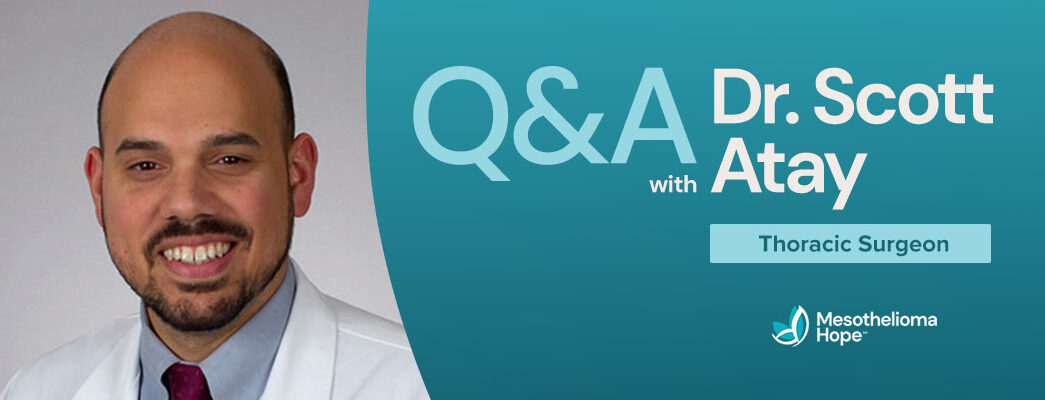


Dr. Scott M. Atay is a thoracic surgeon at USC Norris Comprehensive Cancer Center who specializes in mesothelioma. He trained at Harvard Medical School and MD Anderson Cancer Center, which is known for its leading mesothelioma program.
Before joining USC, Dr. Atay also trained at the National Cancer Institute, where he studied genetic changes in mesothelioma.
Today, he brings that experience to his work with patients, focusing not only on treatment but also on helping them stay grounded and informed.
In this Q&A, he explains who may be a candidate for surgery, how different treatments fit together, and what patients can expect throughout the process.
What does surgery for mesothelioma involve?
The most common operation nowadays for mesothelioma is a pleurectomy with decortication.
You get a fairly sizable incision around your side, your back, and between the ribs. Doctors remove the pleura, which is the lining of the lung. Depending on the extent of disease, the pericardium (the sac around the heart) may also be removed, and then the diaphragm.
The goal is what we call a macroscopic complete resection, which means we get out all the tumor we can see, knowing that there is likely microscopic disease remaining. That’s where systemic therapy comes in.
How do you decide if surgery is an option?
I look at the evaluation for surgical intervention in two categories. One is the patient, and the second is the disease.
Patients who have sarcomatoid or biphasic mesothelioma aren’t really good candidates for surgical intervention, because the disease progresses quickly, and your ability to achieve control of it surgically is limited. There are centers that will still operate on those patients, but obviously, that’s a less favorable outcome.
The second thing is how extensive the disease is. What behavior has that disease shown us thus far? Has it metastasized to regional lymph nodes? As a surgeon, do you think you can preserve that patient’s lung and do a pleurectomy with decortication?
The patient factors are just as important. Did this patient walk in the door saying, “You know what? I’m in good health. I don’t carry other systemic diseases. I’m up for this operation.” Their pulmonary function is adequate. Their cardiovascular function is adequate. We think they can get through this operation. Or are they someone who comes in and is already debilitated?
When you put the patient and disease together, you can make a choice about who’s going to include surgery in their treatment plan. If one of those two isn’t adding up, then we’ll say that surgery isn’t going to be the ideal therapy. It doesn’t mean you can’t still be treated. It just means surgery won’t be a component of that treatment, and that’s OK. We just switch gears a little bit.
Should I get a second opinion?
I wouldn’t get so deep in the weeds that you are delaying your therapy, but definitely consider more than a single opinion.
You shouldn’t feel tethered to one site or institution. If you’re fortunate enough to be in a location where there’s more than one center, or you have the ability to be evaluated at more than one center, you should.
If I say I don’t think you’re a candidate, that just means you’re not a candidate here. You can go across town and see somebody else who might say you are a candidate, and vice versa.
When you have mesothelioma, you want to be seen at a cancer center that has experience with it, or by a surgeon who has experience with it. That’s an important thing to get a good outcome.
How can I prepare for mesothelioma surgery?
Anytime someone’s undergoing an operation on the chest, and more specifically, an operation on the lungs, the most important thing is to come into the operation in the best possible shape you can.
The first thing I tell patients is to walk, walk, walk. If you want to run, you can run, but maintaining physical activity is a really big part of getting through it.
The second thing is nutrition. You get to stop counting calories the same way, because now you’ve got a tumor. That tumor has a metabolic demand that’s beyond the baseline demand of your body. I tell patients to really focus on a diet that’s also rich in protein, because protein is an essential component of being able to heal after an operation.
We’ve got time, and that time allows you to educate yourself so you’re ready for what’s going to happen. Make sure you’ve got family support so you have people to help you when you get home if you need it.
What should I expect during recovery?
After surgery, patients are typically in the hospital for 5 to 7 days. You’ll have several tubes in your chest when you wake up from your operation. Those tubes drain blood and air. After a decortication, air is what tends to leak out, as well as blood for a few days.
Once that seals up, then you get to go home. In most cases, we have a pretty tight follow-up schedule, just because it’s a tough operation. It can come with plenty of risk, and we want to be close for the first month or so.
We usually see the patient within 1 week of discharge and then 2 weeks after that. Once they get about 4 to 6 weeks out, we should be at a point where they’ll be seeing their oncologist again and making decisions about whether they’re going to get additional therapy.
When are chemotherapy or immunotherapy used with surgery?
In most cases, our center tends to favor giving the therapy before surgery, especially chemotherapy. The recovery from surgery can be kind of hard, so we usually give those therapies up front.
Immunotherapy tends to be a little bit better tolerated, so in those cases, they can get treatment before or after. It may not make a difference, but typically we think that before is better, because when you’re getting these immune-based therapies, your body’s able to rev up against the cancer more since it can see the tumor, so to speak.
If the tumor’s already been removed, there’s less antigen or target for your immune system to identify, so we think it’s better to give it up front.
Why do most patients need more than one type of treatment?
In general, mesothelioma requires systemic therapy. In most situations, the goal of surgery for cancer is complete resection, meaning no tumor left behind. Mesothelioma is not that kind of tumor.
The chance of microscopic infiltration into other tissues is high enough that there needs to be an additional way to manage it. So systemic therapy is a component of that.
Systemic therapy is essential for mesothelioma patients in the vast majority of cases. If you don’t have systemic treatment, your risk of recurrence would be very high because we’re just not going to get all the disease.
How do you help patients stay hopeful during treatment?
That’s a big piece, and it’s a tough one. When patients end up in my office as a surgeon, they’re already in this very select group of patients who we’re treating with a goal for complete eradication and long-term survival. As opposed to the bulk of patients, unfortunately, who are diagnosed late, by no fault of anybody.
If there’s one positive of having a rare disease, the communities behind those diseases can be very robust. The ability to connect with people in support groups is something that’s really valuable.
It’s a tall order to go through all these treatments and not know exactly what’s happening. You might be going to a different center that’s not in your hometown, but there’s going to be people around who can help guide you.
Get Help Navigating a Mesothelioma Diagnosis
If you or a loved one has been diagnosed with mesothelioma, it’s normal to have questions about what comes next. This is a rare disease, and many people are learning about it for the first time while also trying to make important decisions.
Mesothelioma Hope is here to help you work through those questions. Our team can help you understand your diagnosis, connect with experienced specialists, and find support resources for you and your family.
Call (866) 608-8933 or contact us online to speak with a Patient Advocate. Whether you’re looking for information, a second opinion, or help finding treatment, we’re here to help you take the next step.