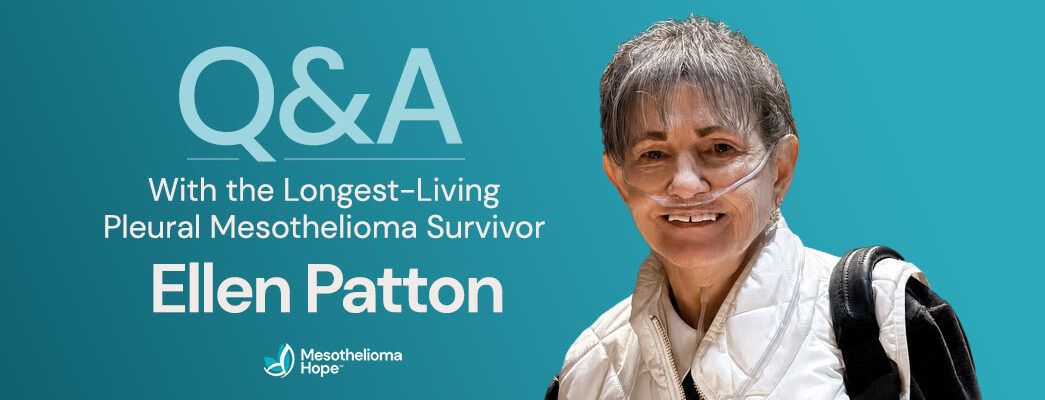


In 2001, Ellen Patton visited her doctor after she started having trouble breathing. She never expected that visit would lead to a pleural mesothelioma diagnosis.
Surgeons opened her up, planning to remove the cancer, and found it had already spread too far. The only other main treatment option at the time, chemotherapy, was too risky. She was given just 12-18 months to live.
Searching for other options to give her more time, Ellen traveled to a clinic in the Bahamas for an experimental immunotherapy treatment years before it became standard care in the U.S., and paid for it herself after her insurance refused to.
Over 25 years later, Ellen is the longest-living pleural mesothelioma survivor. We sat down with her to talk about immunotherapy, the legal case that made paying out of pocket possible, and what a quarter century of living with mesothelioma has actually looked like.
After being told you had just months left, you said you “decided to live.” How did that mindset show up in your daily life?
I did a lot of traveling, and I spent a lot of time with my family. I went to Europe, I went to Bermuda, I took an Alaskan cruise, I toured the Vatican. I acted as though I was going to be here for a while, and that made a big difference for me. I was just in a situation to live however long I had, to squeeze a long life into possibly a shorter one.
I realized that I couldn’t just sit back and wait for anything. If I wanted something, even if I only had a year and a half left, then I needed to get up and do something about it.
I also had a dog that I absolutely adored. When I first got sick, I moved in with my mother, and the dog needed to go out, so I forced myself to walk her. I really think that helped build up my strength a lot.
It really depends on how you look at things and how you fight. You can’t be “poor pitiful me” all the time. Sometimes you can — trust me, sometimes I do — but that’s not going to get me much further in life.
You pursued immunotherapy when it was still considered experimental. What was that experience like?
After everyone told me there wasn’t really anything more that could be done, a friend told me about a clinic in the Bahamas. He knew someone who had gone there for non-Hodgkin’s lymphoma and had been in remission for seven years. So I thought, they’re not giving me any other options, I’m going to the Bahamas.
Every morning, I’d have to go to the clinic, and I had to drive. They drive on the other side of the road there, so that was always an ordeal. They’d draw my blood, and that was the time all the patients had to be there, so I was able to build a group of friends and supporters.
Then, in the afternoon, I’d go back and get shots that were made of the blood samples I gave earlier in the day. I would have to give myself up to 12 shots a day, in my stomach. At first, it was very frightening. After a while, like anything, you get used to it, especially knowing that there’s a good reason for it.
I ended up meeting a couple down there. Penny and I became best friends, and her husband would always go down to the clinic also. We were like the Three Musketeers. Unfortunately, Penny did pass. Not everybody made it. I’m probably one of the luckiest ones at this point. But it definitely was worth every second and every penny that I had.
When did you realize legal compensation was an option?
I first learned of the legal path through the TV. That’s when I really noticed the commercials. I contacted some local attorneys here, and I just wasn’t impressed. One well-known one, you could tell he was just in it for the money, and the other one, I just felt like he was too big, and I was a number.
In the Bahamas, someone told me about the Simmons Hanly Conroy law firm. I got back and contacted them, and firm founder John Simmons himself flew to Baltimore on a snowy day and came to visit with me at the kitchen table. He was so impressive that he sold me right there.
How did filing a mesothelioma lawsuit impact your life?
Insurance covered nothing. My family put together a fundraiser for me and raised $75,000 in one day, and that carried me through treatment until my settlement came through. That settlement was a good $50,000 a year.
Because of the settlement, I was also able to rent an apartment right on the beach in the Bahamas, and I loved waking up every day and seeing that.
I stopped working, which fortunately I was able to do once my case with Simmons Hanly Conroy came through. One of the first things I did was go out and buy a house in the woods on two acres.
The legal process itself required very little of me. They did it all, and anything extra I did, I did that for me. My lawyers were so thorough. It was definitely worth doing.
Do you know how you were exposed to asbestos?
I was exposed to asbestos in several different ways. My father used to work on our house, and we lived there while he was working on it. He was also a professional photographer, and he had pictures of the actual products he was using, with the names on them, so we knew those were the products being used.
All my relatives on my dad’s side worked in the steel mills, and we would go up there and stay for a week at a time. Come to find out, one of the most dangerous jobs for asbestos exposure was in maintenance, and my uncle, who we always stayed with, was in the maintenance department.
There were other situations too, like my hairdryer. Come to find out, it had asbestos in it. I don’t know which fiber did it, what sent me over the limit, but all of those were possibilities.
Working with the law firm’s asbestos investigators was really interesting to me because I wanted to know why. I wanted more answers instead of just settling and going on. It gave me a purpose.
You’ve become a vocal advocate for asbestos awareness. What’s the most rewarding part of that work?
When I was more active with ADAO, I felt like I was accomplishing something, trying to help. ADAO stands for the Asbestos Disease Awareness Organization. It was started by Linda Reinstein, the widow of Alan Reinstein, who died of mesothelioma.
Her main goal was working with the U.S. Senate and lawmakers to get bills passed to eliminate exposure to the general public. She brought in a lot of people who had name recognition, because that was important to the goal.
I wanted to put a face to mesothelioma. It’s not just a word that a lot of people don’t know how to spell.
What have you learned about navigating the health care system?
Today, my doctors don’t understand me. I’ve gotten to the point where I have a big notebook of all my doctors’ notes and surgical notes, and I always bring it to any new doctor I see to show them this isn’t a mistake. I am here, and I have gone through all this.
I had somebody mislabel me in coding for insurance, and it was put down as chronic obstructive pulmonary disease (COPD). Which is true, in a roundabout way, but it was caused by mesothelioma. The coding is really important so you get not only the insurance coverage, but also the treatment you need.
What does living with mesothelioma look like today?
My 93-year-old mother has moved in with me since she’s no longer able to live alone, so my first concern is that she’s taken care of. Getting up, dealing with her situation, getting what she needs, and doing things around the house.
Lots of family comes to visit. I spend my free time doing different things — I make soap, I paint, I cook, and I spend time with family.
I’ve gotten to the point where I’m on oxygen, and it’s not fair to a dog for me not to be able to take it out and run. So I had to re-home my dog, which was a killer, but I have a cat now — she doesn’t need to go for walks.
I have a hard time with steps, but I can do them. Mesothelioma has affected me on a daily basis, so it’s hard not to have it on my mind. But there’s not a whole lot I can do about it, so I just deal with each day.
What would you tell someone who’s just been diagnosed with mesothelioma?
They need to realize the doctors aren’t God, but at the same time, they need to seek out the right doctors and the right people to represent them. It’s important that they have the same goal as you do, and I fortunately hit the lottery with Simmons Hanly Conroy.
Accepting that you can still live is very important. I personally would rather live shorter, happy days than long, miserable days, and that’s how I think you should look at it. It’s important to keep your body healthy and to have positive thinking.
Connect With Mesothelioma Hope
Ellen Patton’s story is proof that a mesothelioma diagnosis doesn’t have to define what comes next.
If you or a loved one has been diagnosed, Mesothelioma Hope can help you find the resources, treatment options, and support you need.
We can help you:
- Connect with top mesothelioma doctors and cancer centers near you
- Learn about the latest treatments, including immunotherapy and clinical trials
- Understand your legal options for compensation
- Access financial and emotional support for you and your family
Call (866) 608-8933 or contact us online to speak with a Patient Advocate today.