

People are often surprised by how much investigative work goes into a mesothelioma legal claim. The diagnosis may be recent, but the exposure that caused it typically occurred decades earlier.
Determining where and how exposure happened may require asbestos attorneys to:
- Review employment records, military service histories, ship records, and product information
- Identify and locate distant co-workers and former corporate employees
- Comb through court filings and evidence gathered over years in other litigation
Those findings can help establish how the exposure occurred and which companies may be legally responsible.
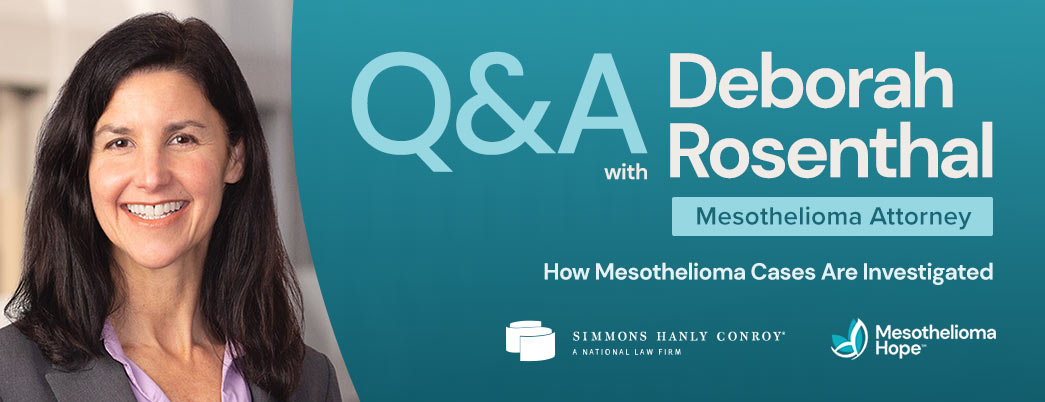
We spoke with mesothelioma attorney Deborah Rosenthal at Simmons Hanly Conroy about how mesothelioma cases are investigated and what families should know when considering their legal options.
What have you learned from representing mesothelioma patients and their families?
One of the first things I’ve learned is that families aren’t usually focused on legal action when they reach out. They’re focused on understanding what happened.
A diagnosis changes everything in a matter of days. People are meeting with doctors, researching treatments, talking with loved ones, and trying to process a disease they may not have known existed until recently.
Amid all of that, they’re also asking a question that’s surprisingly difficult to answer: Where was I exposed to asbestos?
That’s what draws me to this work. I’ve spent most of my career representing people who were harmed because corporations failed to put safety first. In asbestos litigation, we’re often dealing with situations where the corporations knew the risks and exposed people to them anyway.
What qualifies someone for a mesothelioma lawsuit?
At its core, a mesothelioma lawsuit is based on evidence that a person was exposed to asbestos and later developed mesothelioma as a result.
People sometimes assume they don’t have a case because they never worked directly with asbestos or can’t recall exactly where they were exposed. Neither of those things automatically prevents someone from pursuing a claim.
What we’re looking for is a connection between a mesothelioma diagnosis, asbestos exposure, and the companies responsible for that exposure, so we can pursue compensation for our clients.
Exposure may have occurred at a job site, during military service, through a home renovation project, from consumer products, or even through a family member who brought asbestos dust home from work on shoes or clothes.
That’s why I encourage people not to rule themselves out. You don’t need to have every detail before contacting a mesothelioma law firm. In many cases, figuring out how the exposure happened is part of the investigation itself.
What if you don’t know where your asbestos exposure happened?
A large percentage of our clients begin in exactly that position. What surprises many families is how much information can still be uncovered.
Employment records, military records, union documents, Social Security records, historical product information, prior testimony, and corporate records can all help prove asbestos exposure.
I represented a construction supervisor who worked on many projects throughout his career. He couldn’t identify a specific source for his exposure at first.
As we reviewed his work history and compared it to evidence we’d gathered from prior cases, we found he’d been exposed to asbestos-containing pipe and insulation products used at job sites decades earlier.
Cases like that show how your memories don’t have to be perfect at the beginning. The investigation is what helps complete the picture and pursue the compensation that patients and their families deserve.
What sources of asbestos exposure do families most often overlook?
Secondhand exposure is probably the biggest one. People tend to think asbestos was only in places like factories or construction sites. However, asbestos fibers often came home on workers’ clothing, boots, and equipment. Family members could be exposed while doing laundry or cleaning the house.
I represented the wife of a construction worker who developed mesothelioma. She never worked with asbestos. Instead, she was exposed for years through her husband, who had unknowingly brought fibers home with him from work.
Home renovation projects are another source people don’t immediately consider. Older flooring, insulation, joint compound, and other building materials all contained asbestos up until the early 1980s.
We’ve also seen cases involving consumer products. That’s why I encourage people not to make assumptions about where their exposure occurred. A person’s job history is important, but it’s rarely the only place we look.
Can talc asbestos exposure lead to a mesothelioma claim?
Yes. If an attorney can establish that asbestos-contaminated talc contributed to a person’s mesothelioma, that exposure may support a legal claim. This comes up a lot in cases involving women in particular.
Many women diagnosed with mesothelioma never worked with or around asbestos, so we investigate other potential sources, such as personal care products manufactured with talc. We consult with experts in various fields who can help us prove which talcum powder products probably contained asbestos.
In fact, talc has become an increasingly important part of asbestos litigation. We’re seeing more and more cases involving talc exposure. I recently worked on a couple of cases where the asbestos-contaminated talc was in auto body refinishing products.
What are some of your most memorable cases?
The cases that stay with me tend to be the ones where the exposure history wasn’t immediately obvious, and the investigation played a key role in connecting the dots.
One involved an engineer who developed mesothelioma after being exposed to asbestos by contractors working at a Los Angeles-area refinery. We showed how the products and work going on around him contributed to his exposure, ultimately securing $8.2 million on his behalf.
I also represented an electrician whose exposure came from shipboard and railroad electrical work. His case highlighted how many trades and industries were affected by asbestos use. We obtained $6.4 million for his family.
What influence does your journalism background have on your role?
Investigative journalism teaches you to be curious, ask better questions, and keep digging when something doesn’t add up. It also teaches you how to sort through large amounts of information and identify which details matter most.
Those skills are incredibly useful in mesothelioma cases. The exposure may have happened 30, 40, or 50 years ago, so understanding what happened requires research, records, and a willingness to follow the facts wherever they lead.
I still approach cases much like an investigation. My job is to gather the evidence, understand the full story, and present it in a clear and compelling way. Whether a case ends in legal settlements or goes to trial, that process starts with asking the right questions.
How is AI changing the way attorneys build mesothelioma cases?
The discussion around AI tends to focus on whether it can replace professionals. From my perspective, that’s the wrong question.
The more useful question is whether technology can help attorneys work through information more efficiently. In asbestos litigation, we may be reviewing decades of records, deposition transcripts, product documents, employment histories, and medical records.
AI can help organize those materials, identify patterns, and point us toward information that deserves a closer look.
That’s valuable because strong mesothelioma claims are built on evidence. Anything that helps attorneys find, analyze, and connect evidence can improve the investigative process.
At the same time, technology isn’t exercising judgment. It isn’t evaluating witnesses, making strategic decisions, or determining how facts fit together. Those responsibilities still belong to the attorney.
Speak With an Attorney About Your Legal Options
Investigating a mesothelioma case can be challenging, but an experienced asbestos attorney can help identify potential sources of exposure, explain your legal rights, and determine whether compensation may be available.
Deborah Rosenthal and the team at Simmons Hanly Conroy have represented mesothelioma patients and families across the country, securing over $10.6 billion nationwide.
Many mesothelioma claims begin with unanswered questions, and investigating those questions is an important part of the process.
If you or someone you love has been diagnosed with mesothelioma, call (866) 608-8933 or get a free case review to discuss your legal options.
 Get a Free Mesothelioma Case Review