Mesothelioma is one of the rarest and most aggressive cancers in the United States, and not every oncologist has the experience to treat it effectively. Ultimately, where patients live can make the difference between accessible cancer care and massive travel costs.
In this report, Mesothelioma Hope analyzed national health data to rank mesothelioma treatment centers by state, highlighting where care is missing the mark — and is standing by to help families get the care they need, regardless of their location or financial status.
Key Stats on Mesothelioma Treatment Access
Key Stats on Mesothelioma Treatment Access
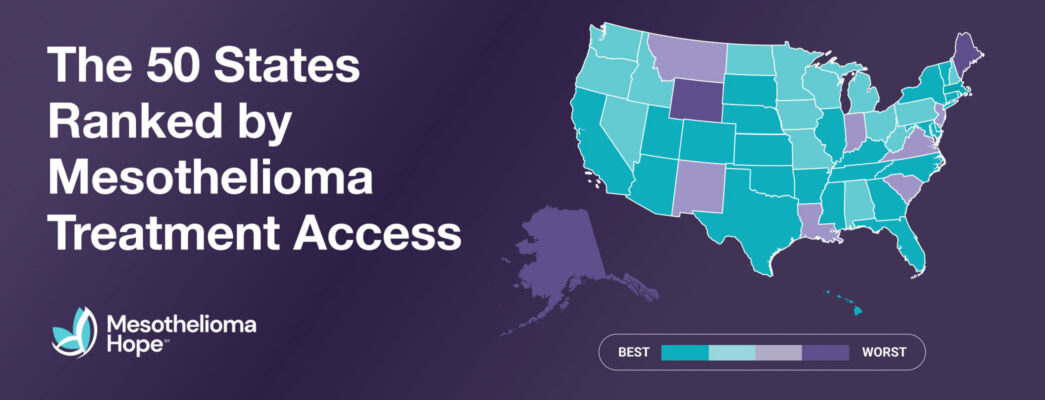
Where you live shapes the care you can reach. We compared every state’s mesothelioma death rate against the specialists available to treat it. A positive gap score means people are dying faster than the state has doctors to treat them; a negative score means specialist access runs ahead of the death rate.
Best and Worst States for Access
Rank by Treatment Gap Score5 Best-Served States
Deepest bench of specialists relative to the death rate.
- #50New York-5.38
- #49Massachusetts-5.11
- #48Nebraska-4.56
- #47Vermont-4.47
- #46Maryland-2.60
5 Most Underserved States
High death rates, few specialists within reach.
- #1Maine+7.12
- #2Alaska+5.53
- #3Wyoming+4.62
- #4Indiana+2.97
- #5Louisiana+2.86
Specialists and Treatment Centers
Nationwide TotalsMesothelioma specialists in the U.S.
Hospitals nationwide that treat mesothelioma
NCI-Designated Cancer Centers nationwide
States with no mesothelioma specialists at all Alaska and Wyoming
The Geographic Gap
One State vs. the Hardest HitMesothelioma specialist facilities in New York alone — more than any other state
Mesothelioma deaths in Maine — the highest rate in the country
The Full 50-State Treatment Gap Rankings
To rank all 50 states, we looked at mesothelioma diagnosis and mortality data from the Centers for Disease Control and Prevention (CDC) WONDER database.
We then compared those numbers with the number of mesothelioma specialists in each state. Both measures were weighted on a 0–10 scale and used to calculate each state’s Treatment Gap Score.
In the chart below, a low or negative score means the state has more specialists available to treat patients. The higher the score, the bigger the treatment gap.
Mesothelioma Treatment Access:
How Every State Ranks
- Well Served
- Moderate Gap
- Significantly Underserved
- Most Underserved
Each state is color-coded by gap score tier. Higher scores indicate higher mesothelioma mortality relative to available specialists.

The Full 50-State Treatment Gap Rankings
Ranked from most to least underserved. The gap score subtracts a state's normalized specialist-access score from its normalized mortality score — a positive score means people are dying of mesothelioma faster than the state has specialists to treat them.
- Most UnderservedGap score 4.0 and above
- Significantly UnderservedGap score 2.0 – 3.9
- Moderate GapGap score 0.0 – 1.9
- Well ServedGap score below 0
per 100K
per 100K
Deaths
Facilities
Specialists
per 100K
Center
Excellence
The 5 Worst States for Mesothelioma Treatment
These states have the highest gap between mesothelioma cases and available specialist care, meaning patients diagnosed here have a harder time getting the right treatments.
The 5 Most Underserved States
These states carry the nation's highest mesothelioma death rates while offering the fewest specialists to treat it. Four of the five have no NCI-designated cancer center at all.
1. Maine
Maine
Ranked #1 — Most UnderservedMaine has the highest mesothelioma mortality rate of any state at 8.52 deaths per 100,000 residents, more than double the national average. Yet, it has just one specialist facility and two mesothelioma physicians serving the entire state.
For many patients living in Maine, the closest mesothelioma cancer centers are in Boston, which can take around 2-6 hours or more to drive to, depending on where in Maine the patient lives. That distance creates a real barrier, both logistically and financially, for families already managing a serious diagnosis.
Find mesothelioma treatment options near Maine
2. Alaska
Alaska
Ranked #2 — 2nd Most UnderservedAlaska has a mesothelioma mortality rate of 5.73 per 100,000, well above the national average. However, according to our directory, there are no mesothelioma specialists treating patients in the state.
The state’s industrial legacy of shipbuilding, extraction of oil and gas, and military operations across the state has left many workers at risk of asbestos-related disease. The nearest mesothelioma treatment programs for Alaska residents are in Seattle, a significant distance that quickly incurs extra costs and strain on the patient.
Find mesothelioma treatment options near Alaska
3. Wyoming
Wyoming
Ranked #3 — 3rd Most UnderservedWyoming has a mesothelioma mortality rate of 5.16 per 100,000. Like Alaska, our research found no mesothelioma specialists practicing in the state. Wyoming has two cancer facilities, but we didn’t find physicians at either who specialize in treating mesothelioma.
The state also has a long history of industries where workers faced asbestos exposure, including mining and oil and gas work. U.S. veterans may have been exposed to asbestos during military service as well. People who develop mesothelioma in Wyoming may need to travel to Denver or another out-of-state center for specialized care.
Find mesothelioma treatment options near Wyoming
4. Indiana
Indiana
Ranked #4 — 4th Most UnderservedIndiana is home to the Indiana University Melvin and Bren Simon Cancer Center, which is a National Cancer Institute (NCI) Designated Cancer Center. This means it provides comprehensive cancer care and helps develop new treatments.
However, there are only two mesothelioma specialists in the entire state. This gives it one of the lowest specialist-per-capita ratios among states with NCI access. As a result, patients spread throughout the state may need to drive long distances or even fly to get care.
Find mesothelioma treatment options in Indiana
5. Louisiana
Louisiana
Ranked #5 — 5th Most UnderservedLouisiana has a mesothelioma mortality rate of 5.69 per 100,000, one of the highest in the country. The state has two facilities in our directory: Ochsner Health and the LSU-LCMC Health Cancer Center in New Orleans.
While both centers have experienced mesothelioma doctors on staff, per-capita access remains significantly below what the state’s disease burden warrants.
Find mesothelioma treatment options in Louisiana
Expert Panel Question
For a patient newly diagnosed with mesothelioma in a state with few specialists, what is the single most important first step they should take to access appropriate care?

“I think it’s always good to get second or third opinions, especially with something like this. But what’s more important is for people to see someone that’s experienced in mesothelioma. If you see somebody who sees one case of mesothelioma a year, they’re going to have a very biased view of it.
Just because someone’s a thoracic surgeon doesn’t mean they see a lot of mesothelioma, and just because someone’s an oncologist doesn’t mean they see a lot of mesothelioma. So you want to see someone who’s a real mesothelioma specialist.”
The Top 5 Best States for Mesothelioma Treatment
The states below are home to a wide range of doctors and cancer centers that can treat mesothelioma, allowing patients to more conveniently access the care they deserve.
The 5 Best-Served States
These states have the deepest bench of mesothelioma specialists relative to their death rates. New York alone has more named specialists than the 20 lowest-ranked states combined.
1. New York
New York
Ranked #50 — Best ServedNew York has more doctors and cancer centers treating mesothelioma than any other state. It’s home to 11 mesothelioma cancer centers and 76 mesothelioma physicians, with world-renowned programs at Mount Sinai Hospital, Weill Cornell Medical Center, and more.
The state’s relative mortality rate of 3.72 per 100,000 is below average, but the sheer concentration of specialists makes it the leader in mesothelioma treatment. Patients from out of state often travel to doctors in New York to get expert care.
Find mesothelioma specialists in New York
2. Massachusetts
Massachusetts
Ranked #49 — 2nd Best ServedMassachusetts is home to Dana-Farber Cancer Institute and Brigham and Women’s Cancer Center, which together operate one of the most comprehensive mesothelioma programs in the world.
The combined Dana-Farber/Brigham program has over 30 specialists on staff who treat state residents and patients from around the country. Some of the longest-living mesothelioma survivors, including 29-year survivor Sissy Hoffman, received treatment in Massachusetts.
Find mesothelioma specialists in Massachusetts
3. Nebraska
Nebraska
Ranked #48 — 3rd Best ServedNebraska is home to the Fred & Pamela Buffett Cancer Center, where patients can access specialized cancer care through Nebraska Medicine and the University of Nebraska Medical Center.
Its strong specialist availability relative to its population helps make Nebraska one of the best-served states for mesothelioma care.
Find mesothelioma specialists in Nebraska
4. Vermont
Vermont
Ranked #47 — 4th Best ServedVermont patients can access specialized cancer care at the University of Vermont Medical Center, the state’s major academic medical center.
Despite Vermont’s high mesothelioma mortality rate, its specialist availability relative to its small population helps it rank among the best-served states.
Find mesothelioma specialists in Vermont
5. Maryland
Maryland
Ranked #46 — 5th Best ServedMaryland is home to the Sidney Kimmel Comprehensive Cancer Center at Johns Hopkins, an NCI-Designated Comprehensive Cancer Center offering specialized care for complex cancers.
Along with other specialist programs in the state, this gives Maryland residents relatively strong access to mesothelioma expertise.
Find mesothelioma specialists in Maryland
Expert Panel Question
Does it matter whether a mesothelioma patient is treated by a general oncologist vs. a mesothelioma specialist — and what’s the practical difference in outcomes?

“Mesothelioma is a rare and complex cancer, requiring a specialized, multidisciplinary approach for the best outcomes, including a team of oncologists, thoracic surgeons, pulmonologists, and palliative care experts who can work together to develop the best plan for each patient.
Patients treated at high-volume specialized centers tend to have better survival rates and improved quality of life.”
3 Key Factors Driving the Treatment Gap
The gap between the best- and worst-served states is not random. Factors like disease burden (the number of cases and deaths), lack of NCI-Designated Cancer Centers, and states with high rural populations all play a role.
1. Industrial History
States with high mesothelioma mortality rates were home to industries like shipbuilding, manufacturing, and automotive work. Asbestos was used extensively across these industries through the early 1980s.
The 10-to-50-year latency period of mesothelioma means workers exposed decades ago are only now being diagnosed.
Industries with high rates of asbestos exposure include:
- Automotive manufacturing
- Construction and insulation work
- Military service (particularly U.S. Navy and U.S. Army veterans)
- Oil and gas extraction
- Paper mills and logging
- Shipbuilding and naval construction
- Steel and iron manufacturing
Older adults in Maine, Louisiana, West Virginia, and Montana who worked with asbestos decades ago may struggle to get mesothelioma treatments close to home.
2. Concentration of NCI-Designated Cancer Centers
The Concentration of NCI-Designated Cancer Centers
Only 74 NCI-Designated Cancer Centers exist in the United States. They receive dedicated federal funding for cancer research and treatment, and many leading mesothelioma doctors practice inside them. Fifteen states have none at all — including four of the five states with the worst treatment gaps.
The 15 states with no NCI-Designated Cancer Center
Specialists
All 15 states combined still trail a single state
Specialists
Indiana is the only state among the five worst that has an NCI-Designated Cancer Center — yet our directory lists just two mesothelioma doctors for the entire state. A center nearby does not guarantee a specialist within reach.
There are only 74 NCI-Designated Cancer Centers in the United States. These centers receive dedicated federal funding for cancer research and treatment. Some of these facilities are where leading mesothelioma doctors work to diagnose and treat patients.
Of the five worst states for mesothelioma treatment, four have no NCI-Designated Cancer Center. Only Indiana had one, but our database listed only two mesothelioma doctors for the entire state.
3. Rural Population and Travel Burden
Many of the worst states for mesothelioma treatment are also among the most rural. For many patients in Wyoming, Alaska, or Montana, the nearest mesothelioma specialist may be hundreds of miles away.
Research consistently shows that travel distance to specialty cancer care is associated with worse outcomes and lower rates of receiving stage-appropriate treatment.
Patients who can’t travel are more likely to be treated by general oncologists with limited mesothelioma experience, receive inadequate treatments, and miss opportunities for clinical trials.
Expert Panel Question
What options do mesothelioma patients in rural or underserved states have when the nearest specialist is hundreds of miles away? Is telehealth or second-opinion consultation a viable path?

“A lot of [mesothelioma patients] will come here from kind of far away, and they’ll get their care plan instituted, and they’ll get it carried out closer to home. And sometimes some of the people near where they live are just sort of carrying out a recipe that has been written down somewhere else. And so they don’t really have somebody locally who they can talk to about that sort of stuff.
So I just tell them to just call us. I’ll do virtual visits. I’ll call them on the phone. They don’t have to schlep into the office and see me. I think just knowing that somebody’s there to help you is important.”
Top Findings from Our Mesothelioma Treatment Gap Analysis
Beyond the state rankings, our analysis identified several findings that help distinguish states with the best mesothelioma treatment centers from those with the worst.
Here are 6 points on the best and worst mesothelioma treatment centers by state:
- Maine’s mortality rate is more than double the national average. At 8.52 deaths per 100,000 residents, this is the highest of any state.
- Two states have no known mesothelioma specialists. Alaska and Wyoming both have cancer facilities, but neither has physicians on staff who explicitly focus on mesothelioma.
- NCI centers may not always close the care gap. Indiana, Iowa, and New Mexico all have NCI centers yet rank among the 15 most underserved states.
- New York has the most specialists. With 76 mesothelioma doctors across 11 facilities, New York is well prepared to support patients in the state and those traveling from across the country.
- There are 11 states with Centers of Excellence designations. California, Florida, Illinois, Massachusetts, Minnesota, North Carolina, New York, Ohio, Pennsylvania, Texas, and Utah each have at least one facility recognized as a Center of Excellence.
- The treatment gap is a health equity issue. States with lower per-capita income and larger rural populations consistently rank near the bottom.
At Mesothelioma Hope, we believe that all patients deserve access to the best treatments, regardless of where they live. Call (866) 608-8933 now for help finding and affording medical care after a mesothelioma diagnosis.
What to Do If You’re in an Underserved State
Being diagnosed with mesothelioma in a state with limited specialist access doesn’t mean you’re out of options.
Follow these steps to access the best care regardless of where you live:
- Seek a second opinion from a mesothelioma specialist. General oncologists rarely see mesothelioma cases. A specialist who regularly treats mesothelioma will have access to treatments that a general practitioner may not. Many major centers offer remote second opinions by mail or telehealth.Mesothelioma Treatment Access
Why a Second Opinion From a Specialist Matters
General oncologists rarely encounter mesothelioma. A doctor who treats it regularly has access to procedures, trials, and diagnostic expertise a general oncologist may not — and many major centers now offer second opinions by mail or telehealth, without travel.
Mesothelioma Specialist
- ✓Treats mesothelioma routinely — often dozens of cases a year
- ✓Multidisciplinary tumor board reviews each case
- ✓High-volume surgical experience with mesothelioma-specific procedures
- ✓Access to clinical trials and treatments not offered at community hospitals
- ✓Pathologists experienced in distinguishing mesothelioma subtypes
- ✓Remote second opinions available by mail or telehealth
General Oncologist
- –May see only one or two mesothelioma cases in an entire career
- –Limited surgical volume for mesothelioma-specific procedures
- –May not have access to the newest mesothelioma protocols or trials
- –Subtype determination may be less precise, which can affect eligibility
- ✓Local — no travel required for ongoing chemotherapy or radiation
- ✓Can co-manage care under guidance from a remote specialist
- Ask about telehealth consultations. Several major mesothelioma programs, like those at Dana-Farber, MD Anderson, and Memorial Sloan Kettering, now offer remote consultation services. A telehealth visit with a specialist can help you understand your options without requiring immediate travel.
- Consider traveling for surgery. If mesothelioma surgery is part of your treatment plan, you may want to travel to ensure it’s done by a specialist. Other treatments like chemotherapy may not require travel.
- Ask about clinical trials. Clinical trials are often available at major cancer centers and may be an option if your mesothelioma doesn’t respond to standard treatments. If you qualify for a trial, you may have your travel and lodging covered.
- Use Mesothelioma Hope’s Free Doctor Match service. Our team can help connect you with a mesothelioma specialist near you at no cost.
- Explore financial assistance for travel. Many nonprofit organizations offer travel and lodging grants to cancer patients who have to travel for specialty care. View a full list of financial assistance resources.
- Speak with a mesothelioma attorney. You may be able to access compensation worth over $1 million on average by working with a mesothelioma lawyer. This money can help pay for the costs of travel, treatment, and much more.
All of these steps are excellent ways to access and afford the care you need after a mesothelioma diagnosis — even if travel needs to be factored in.
Expert Panel Question
For patients in states without mesothelioma specialists, what should they look for when evaluating whether a general oncologist is equipped to manage their care — and when is it essential to travel?

“If there isn’t a mesothelioma specialist near you, you may still be able to get good care close to home. Look for an oncologist with experience treating rare cancers. I’d also ask if they’re willing to work with a mesothelioma specialist. Your local doctor can often handle day-to-day care while the specialist helps guide your treatment.
Travel may be worth it for surgery, a clinical trial, or a treatment you can’t get locally. I’d also consider seeing a specialist if your treatment stops working or you want a second opinion. You may not need to travel for every appointment, but it’s important to have the right expertise involved in your care.”
Why It’s Important to Get Care From Top Mesothelioma Treatment Centers
There’s no cure for mesothelioma yet, but getting treatment at a specialist center can potentially extend survival and improve quality of life.
Pleural mesothelioma patients treated at high-volume surgical centers live longer on average than those treated at general hospitals.
Peritoneal mesothelioma patients who receive cytoreduction with HIPEC at an experienced center have significantly better outcomes than those who do not.
What mesothelioma cancer centers offer:
- Access to systemic treatments like chemotherapy and immunotherapy
- Medical teams that develop treatment plans specific to each case
- Pathology departments experienced in distinguishing mesothelioma cell types (which can greatly impact treatment planning)
- Surgeons who regularly perform surgeries like pleurectomy with decortication (P/D) and extrapleural pneumonectomy (EPP)
- Additional support staff such as nurses, therapists, nutritional counselors, and more
These resources are essential to giving mesothelioma patients the best chance of living longer with fewer symptoms.
Compensation for Mesothelioma Patients in Underserved States
The costs of traveling to a specialist center, such as flights, hotels, meals, and time away from work, add a financial burden on top of an already devastating diagnosis. But for many mesothelioma patients, legal support can help.
Mesothelioma Hope has partnered with Simmons Hanly Conroy, a national mesothelioma law firm that has helped patients not only recover significant compensation but also more easily access the treatments they need.
Our legal partners:
- Can help eligible clients in all 50 states
- Have nurses who can help you find top doctors
- Meet with you at your convenience with no travel required
- Pursue asbestos settlements worth over $1 million on average
- Recover payouts from asbestos trust funds ($30 billion available)
Get a Free Case Review now to find out if you can work with our partner mesothelioma law firm. There are no upfront fees to file a legal claim if you qualify.
 Get a Free Mesothelioma Case Review


Finding Mesothelioma Specialists Near Me
Our data shows that state-to-state mesothelioma treatment gaps can have a significant impact on patient outcomes. When states have fewer doctors and cancer centers, patients may be forced to travel to get treatments they need just to survive.
The good news is that Mesothelioma Hope may be able to help you access treatment no matter where you live. For more than 25 years, we’ve supported over 8,900 families across all 50 states.
Our team is ready to help you:
- Find top mesothelioma specialists
- Compare leading cancer centers
- Review available treatment options
- Find clinical trial opportunities
- Pursue compensation for expenses
Use our Free Doctor Match now or call (866) 608-8933 to connect with our Patient Advocates and get started.
About This Analysis
Mesothelioma Hope examined mesothelioma diagnosis and mortality data alongside the availability of specialist treatment resources for all 50 states.
This was done using two datasets:
- CDC WONDER Cancer Statistics: This included federal mesothelioma incidence (1999-2022) and mortality (2018-2023) records for all 50 states.
- Mesothelioma Hope Medical Resources Directory (April 2026): A curated list of cancer centers and specialists across the country that specifically treat mesothelioma.
We used two components to calculate the treatment gap score:
- Mortality Score: Each state was scored on its mesothelioma death rate per 100,000 residents, normalized to a 0-10 scale. Higher scores indicate states where mesothelioma claims more lives per capita.
- Treatment Access Score: We ranked states based on the number of specialists relative to the overall population on a 0-10 scale.
Mortality Score − Access Score = Gap Score. A lower or negative score meant that the state had more specialists available to treat patients. The higher the score, the bigger the treatment gap.
Mesothelioma Treatment Access FAQs
What is the difference between a mesothelioma specialist and a general oncologist?
A mesothelioma specialist is a physician, typically a thoracic surgeon, thoracic medical oncologist, or surgical oncologist, who treats mesothelioma regularly and has specific expertise in the disease.
Because mesothelioma is rare, most general oncologists see only a handful of cases in their careers.
Seeing a specialist means you’ll be working with someone who has treated many other mesothelioma patients successfully, giving you peace of mind that you’re getting expert care.
Can I see a mesothelioma specialist if I don't live near one?
Yes, in several ways. Many major mesothelioma programs offer remote second-opinion services by mail or video consultation.
Some patients receive their initial consultation at a specialist center, then return home for chemotherapy or radiation delivered by a local oncologist, with ongoing remote oversight from the specialist.
Finally, travel assistance programs and financial compensation from asbestos litigation can also help cover the cost of in-person specialist visits.
We’re ready to help you find top mesothelioma doctors in your area. Call (866) 608-8933 to get started.
What is an NCI-Designated Cancer Center?
The National Cancer Institute designates a select group of cancer centers that meet rigorous standards for research, treatment, and community outreach.
There are currently only 74 NCI-Designated Cancer Centers in the United States. These centers are more likely to have physicians experienced in mesothelioma, access to clinical trials, and multidisciplinary tumor boards than community hospitals.
What is a Center of Excellence for mesothelioma?
A Center of Excellence (COE) designation indicates a facility with a dedicated mesothelioma program, not just physicians with individual experience.
These 11 states have at least one COE facility:
- California
- Florida
- Illinois
- Massachusetts
- Minnesota
- New York
- North Carolina
- Ohio
- Pennsylvania
- Texas
- Utah
COE facilities have established multidisciplinary mesothelioma teams ready to offer specialized treatments to patients.
What should I do if I've been diagnosed with mesothelioma in an underserved state?
Contact Mesothelioma Hope as soon as possible. We’re ready to help support you after a mesothelioma diagnosis.
Our Patient Advocates can help you:
- Find the nearest mesothelioma cancer center
- Get a second opinion in person or remotely
- Pursue financial resources to cover travel and treatment
- Explore clinical trials and emerging therapies
To get started, use our Free Doctor Match service to find a mesothelioma specialist near you.