
Mesothelioma From Asbestos on Navy Ships
Anyone who worked on or near Navy ships from the 1930s to the early 1980s could have been exposed to asbestos, the only known cause of mesothelioma cancer. Asbestos was used in many products on naval ships to make them more fireproof and seaworthy. Over 3,300 vessels are now known to have contained asbestos-based materials.
When equipment like pipes and boilers were installed or repaired, they released clouds of asbestos. Because of the close quarters and poor ventilation on Navy ships, service members could easily breathe in or swallow asbestos fibers. This can lead to health complications later on, with some Navy veterans developing mesothelioma 10-50 years after asbestos exposure.

“Veterans are at particularly high risk of getting mesothelioma because asbestos was used in so many products that were purchased by the U.S. military. Navy vessels in particular used asbestos in many different ways.”
If you are a veteran with mesothelioma from being exposed to asbestos on U.S. Navy ships, you may be eligible for disability payouts, free or low-cost health care, and other benefits.
Download our Free Veterans Compensation Guide to learn more about different types of financial support for military families affected by mesothelioma.

List of U.S. Navy Ships With Asbestos
The U.S. Navy used asbestos products in every ship built before the mid-1980s without knowing the health risks. Use our database below to see if a ship you served on contained asbestos.
- Type of Ship:
- Asbestos Used: Yes
Learn more about asbestos on Navy ships in our Free Veterans Guide.
Get Your Free Guide or call (866) 608-8933Auxiliary Ships
The U.S. Navy used auxiliary ships to support combat ships and other naval operations.
Many asbestos materials were used onboard auxiliary ships in gaskets, electrical wiring, soundproofing, spray-on insulation, and more.
Auxiliary ships that contained asbestos include:
- USS Ajax (AR-6)
- USS Alacrity (AG-520)
- USS Amphion (AR-13)
- USNS Apache (ATF-172)
- USS Assurance (AG-521)
- USS Beaver State (ACS-10)
- USS Briareus (AR-12)
- USS Cadmus (AR-14)
- USS Cheyenne (AG-174)
- USS Compass Island (AG-153)
- USS Cornhusker State (ACS-6)
- USS Delta (AR-9)
- USS Diamond State (ACS-7)
- USS Equality State (ACS-8)
- USS Flickertail State (ACS-5)
- USS Flint (AE-32)
- USS Flyer (AG-178)
- USS Fomalhaut (AE-20)
- USS Gem State (ACS-2)
- USNS Glomar Explorer (AG-193)
- USS Gopher State (ACS-4)
- USS Grand Canyon (AR-28)
- USS Grand Canyon State (ACS-3)
- USS Green Mountain State (ACS-9)
- USS Gudgeon (SSAG-567)
- USNS Hayes (AG-195)
- USS Hector (AR-7)
- USS Jason (AR-8)
- USS Keystone State (ACS-1)
- USNS Kingsport (AG-164)
- USS Klondike (AR-22)
- USS Liberty (AG-168)
- USS Markab (AR-23)
- USS Mississippi (AG-128)
- USS Monob One (YAG-61)
- USNS Phoenix (AG-172)
- USNS Provo (AG-173)
- USNS Pvt. Jose F. Valdez (AG-169)
- USS Saluda (YAG-87)
- USS Sequoia (AG-23)
- USNS Sioux (ATF-171)
- USNS S.P. Lee (AG-192)
- USNS Spokane (AG-191)
- USS Utah (AG-16)
- USNS Vanguard (AG-194)
- USS Wyoming (AG-17)
Because these ships handled many everyday jobs, crew members often worked near asbestos during regular repairs and maintenance.


U.S. Marine Corps Major J.N. Nelson explains why Navy veterans face some of the highest risks of mesothelioma. View Transcript.
Duration: 1 min 41 sec
Veterans are at a particularly high risk of getting mesothelioma because asbestos was used in so many products purchased by the U.S. military. The branch with the greatest exposure is probably the U.S. Navy. We find that about a third of the people we come across with asbestos-related diseases served in the Navy. That’s largely because so many Navy vessels — practically all of them from the 1930s into the 1980s — were built using asbestos products for fireproofing, insulation, and soundproofing.
If I met a veteran who was exposed to asbestos in the service, I would say he needs to get checked by his doctor on a regular basis. He should keep an eye out for signs and symptoms of mesothelioma, like shortness of breath and similar issues. It’s also important to keep a good record of what you did in the service — where you served, what ships you were on, and what vessels or equipment you worked with.
A lot of times, veterans come to us and say, “I don’t know how this happened. I don’t know when this occurred.” Fortunately, we have a database — a warehouse of information — that tells us which vessels, buildings, equipment, or even protective gear contained asbestos. We can take that service member’s record and fill in the blanks, figuring out where possible exposures occurred while he was on active duty.
You want to have a good record of these things so that if you ever have to file a claim with the VA, for example, to get a disability rating, you’ll have the information you need for your claim to be approved.
Battleships
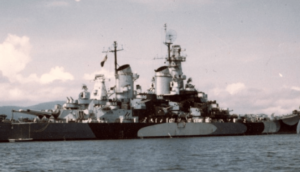
Battleships were the backbone of the U.S. Navy during World War II. Their massive firepower and thick armor made them essential during naval battles in the Pacific and Atlantic oceans.
The interiors of battleships were insulated with asbestos-based products to protect them from enemy fire.
Battleships that contained asbestos include:
- USS Arizona (BB-39)
- USS Indiana (BB-58)
- USS Iowa (BB-61)
- USS Maryland (BB-46)
- USS Massachusetts (BB-59)
- USS Michigan (SSBN-727)
- USS Missouri (BB-63)
- USS North Carolina (BB-55)
- USS Washington (BB-56)
- USS Wisconsin (BB-64)
Asbestos was especially common on battleships because their heavy armor and high-heat equipment required extensive insulation.
Cruisers
The versatile nature of Navy cruisers helped them fulfill a variety of roles, like escorting larger ships and destroying enemy warships. Asbestos was used in a wide range of equipment found on cruisers, from turbines to electrical wiring.
Cruisers that contained asbestos include:
- USS Bainbridge (CGN-25)
- USS Bunker Hill (CG-52)
- USS Fox (CG-33)
- USS Houston (CL-81)
- USS Long Beach (CGN-9)
- USS Macon (CA-132)
- USS Pittsburgh (CA-72)
- USS South Carolina (CGN-37)
- USS Valley Forge (CG-50)
- USS Washington (CA-11)
Many cruisers went through repeated upgrades over the years, which meant their original asbestos materials were often disturbed during overhaul work.
Destroyers
Destroyers were used to escort larger ships and protect them against enemy submarines and aircraft. Asbestos materials were used in valves, gaskets, and many other parts on destroyers for over 50 years.
Destroyers that contained asbestos include:
- USS Badger (DD-126)
- USS Benner (DD-807)
- USS Doyen (DD-280)
- USS Fox (DD-234)
- USS Healy (DD-672)
- USS McFarland (DD-237)
- USS Pringle (DD-477)
- USS Swanson (DD-443)
- USS Talbot (DD-114)
- USS Uhlmann (DD-687)
Destroyers were repaired frequently while still in service, making it more likely that sailors would encounter worn or damaged asbestos insulation and other materials.
You may have been exposed to asbestos if you served aboard a destroyer or other Navy ship. Learn more about getting support and resources for an asbestos-related illness from service in our Free Veterans Compensation Guide.
Frigates
Navy frigates were equipped with sonar to detect submarines during World War II. Anyone who served on a frigate before the early 1980s may have been exposed to ship components made with asbestos.
Frigates that contained asbestos include:
- USS Aylwin (FF-1081)
- USS Bagley (FF-1069)
- USS Blakely (FF-1072)
- USS Connole (FF-1056)
- USS Gallery (FFG-26)
- USS Knox (FF-1052)
- USS Oliver Hazard Perry (FFG-7)
- USS Reasoner (FF-1063)
- USS Stark (FFG-31)
- USS Thach (FFG-43)
Because the machinery and sonar gear on frigates were packed in so tightly, crews often had to work right next to equipment wrapped in asbestos insulation. This meant it was more likely for them to risk regular exposure.
Minesweepers
From World War II onward, minesweepers played an essential role in destroying sea mines and allowing safe passage for other Navy ships.
However, the Navy sailors who worked in close quarters on minesweepers were put at high risk of asbestos exposure.
Minesweepers that contained asbestos include:
- USS Avenge (AM-423)
- USS Defense (AM-317)
- USS Energy (AM-43)
- USS Indicative (AM-250)
- USS Kingfisher (AM-25)
- USS Peregrine (AM-373)
- USS Surfbird (AM-383)
- USS Triumph (AM-323)
- USS Velocity (AM-128)
- USS Waxwing (AM-389)
To keep minesweepers light enough for their missions, shipbuilders used asbestos-containing materials because they could resist fire while adding very little weight.
Submarines
The Navy relied heavily on submarines during and after World War II to gather intelligence and destroy enemy vessels.
Submarines built before the early 1980s had a variety of asbestos-based materials onboard to keep them fireproof and resistant to corrosion from salt water.
Submarines that contained asbestos include:
- USS Hammerhead (SSN-663)
- USS James Madison (SSBN-627)
- USS Kamehameha (SSN-642)
- USS New York City (SSN-696)
- USS Rasher (SS-269)
- USS Salmon (SS-573)
- USS Snook (SSN-592)
- USS Spearfish (SS-190)
- USS Tecumseh (SSBN-628)
- USS Will Rogers (SSBN-659)
Since submarines don’t have much open space, asbestos dust often stayed in the air longer, which meant crew members were more likely to be exposed over time.
Other U.S. Navy Ships With Asbestos
Asbestos use on amphibious warships, cutters, patrol boats, and other types of Navy ships also put veterans at risk of asbestos-related diseases like mesothelioma and lung cancer later in life.
Other types of Navy ships with asbestos-containing products include:
- Ammunition freighters
- Amphibious assault craft
- Aircraft carriers
- Coast Guard cutters
- Corvettes
- Destroyer escorts
- Escort carriers
- Explosives freighters
- Hospital vessels
- Landing craft
- Liberty ships
- Merchant marine ships
- Oilers and tankers
- Patrol boats
- Troop carriers
Asbestos materials were used on almost every type of ship before the early 1980s for the perceived benefits, with Navy service members not knowing the health risks that were hidden by manufacturers.
Norm’s Story: Asbestos Exposure in Navy Ships

In 1949, Norm started helping out in his family’s HVAC business at just 12 years old. Never afraid of hard work, and committed to serving his country, he went on to join the U.S. Navy. During this time, he made boiler plates for nuclear submarines and was routinely exposed to asbestos in the process.
Norm was diagnosed with mesothelioma 61 years after he first started working with asbestos-containing products. Norm and his wife, Gail, decided to file a lawsuit to help pay for family expenses while he struggled with the disease. They reached out to Simmons Hanly Conroy, a leading mesothelioma law firm, for support.
“Norm had no idea that the materials he was working with on a daily basis would eventually result in a fatal disease. Not once during his long career working with asbestos was he ever warned about its hazards.”
– Taylor Kerns, attorney for Norm, a Navy veteran and mesothelioma patient
Norm was able to pay off his mortgage thanks to his mesothelioma settlement, giving him peace of mind for his family’s future. The experienced team at Simmons Hanly Conroy can help evaluate your family’s options, too. Get a Free Case Review today.
 Get a Free Mesothelioma Case Review

List of U.S. Shipyards with Asbestos
U.S. shipyards were crucial hubs for the construction, repair, and maintenance of naval and civilian vessels. However, they also became hotspots for asbestos exposure because of the extensive use of asbestos products in shipbuilding.
Shipyards across the country used asbestos, such as:
- Bethlehem Steel Shipyard (Maryland)
- Brooklyn Navy Yard (New York)
- Charleston Naval Shipyard (South Carolina)
- Long Beach Naval Shipyard (California)
- Mare Island Naval Shipyard (California)
- Newport News Shipbuilding and Drydock Company (Virginia)
- Norfolk Naval Shipyard (Virginia)
- Philadelphia Naval Shipyard (Pennsylvania)
- Puget Sound Naval Shipyard (Washington)
Tasks like cutting metal, grinding parts, or stripping insulation in these shipyards frequently released high levels of asbestos dust into the air.
Navy Ship Jobs With a High Risk of Asbestos Exposure
All veterans who served aboard U.S. Navy ships that used asbestos were at risk of exposure, but some were in more danger than others.
Sailors below deck and engineers worked in confined and poorly ventilated spaces like engine and boiler rooms, where they could easily breathe in or swallow asbestos dust.
Jobs on Navy ships with the highest risk of exposure include:

- Boilerman (BT): Worked in boiler rooms where asbestos was used as insulation around boilers and pipes
- Electrician’s Mate (EM): Handled electrical wiring and components that were often insulated with asbestos
- Engineman (EN): Operated and serviced engines that contained asbestos insulation
- Fire Control Technician (FT): Worked near asbestos-insulated equipment to control ship weapons and fire systems
- Hull Maintenance Technician (HT): Repaired and maintained the ship’s hull, including asbestos-lined bulkheads and decks
- Machinist’s Mate (MM): Maintained and repaired machinery with asbestos-containing gaskets and insulation
- Shipfitter (SF): Fabricated and assembled metal parts, frequently working in asbestos-insulated areas
Service members in these roles often worked near insulation and constantly running machinery, which increased their risk of asbestos exposure.
Other High-Risk Jobs on Mesothelioma Navy Ships
Asbestos exposure on Navy ships wasn’t limited to one type of work. Many sailors spent long hours in cramped, poorly ventilated areas. Because of this, a wide range of jobs came with a risk of asbestos exposure that veterans might not have realized at the time.
Some of the other occupations that often faced asbestos exposure include:
- Engine room technicians
- Gunnery technicians
- Instrument technicians
- Insulators and painters
- Mechanics
- Panel installers
- Plumbers
- Sonar technicians
- Tile setters
- Water tenders
- Weapons specialists
- Welders and steel fabricators
Get your Free Veterans Compensation Guide to learn more about filing for VA benefits and pursuing financial compensation after a mesothelioma diagnosis.
Products With Asbestos in Navy Ships
From the 1930s through the early 1980s, the U.S. Navy used more than 300 different asbestos-containing products. Because these materials were heat-resistant and durable, they became standard components in nearly every part of ship construction.
Asbestos products found on Navy ships included:
- Adhesives
- Boilers
- Capacitors and meters
- Cement powder and mortar mix
- Deck and floor tiles
- Dielectric paper and relays
- Electrical wire coatings
- Fireboxes and liners
- Gaskets
- Instruments
- Instrument paneling
- Packings
- Paint and wallboard
- Pipe coverings
- Pumps
- Sealants
- Soundproofing materials
- Spray-on insulation
- Valves
Because so many products contained asbestos, exposure was likely for countless servicemembers who had no idea of the dangers.
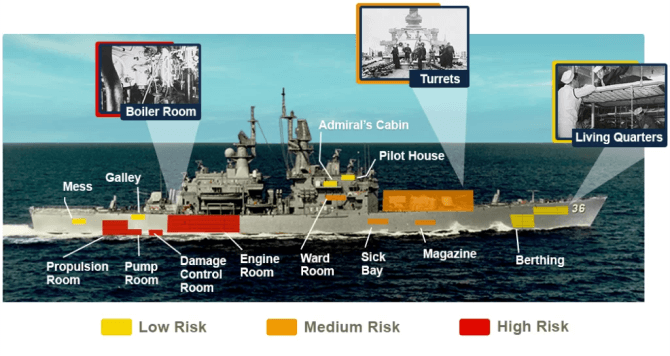
The image below shows specific areas where asbestos on Navy ships could be found.
When Was Asbestos Removed From Navy Ships?
Asbestos was banned and started being removed from Navy ships in the late 1980s once the health risks became more widely known.
Asbestos removal was a large undertaking that often occurred during regular ship maintenance and overhauls. There was a strong push to reduce asbestos on active ships, but because it was so complex and expensive, it took a long time to fully remove it.
Even today, a handful of older ships still contain some asbestos products, but they are monitored to keep service members safe.
Navy veterans who served on ships prior to the 1980s can stay on top of their health by being aware of any new health concerns, going to their doctor regularly, and knowing the symptoms of mesothelioma.
Compensation After Asbestos Exposure on Navy Ships
Veterans who developed mesothelioma or another asbestos-related illness after working on Navy ships with asbestos deserve to be supported. Financial compensation can come in the form of VA benefits, lawsuit settlements, or asbestos trust fund payouts.
Compensation for Navy veterans with mesothelioma includes:
- VA benefits: Former service members may be eligible for veterans benefits from the U.S. Department of Veterans Affairs (VA). Mesothelioma disability VA claims award $4,158.17 tax-free every month if you’re married. You may also qualify for free or low-cost medical care through the VA health care system or caregiver support through Aid and Attendance or Housebound benefits.
- Mesothelioma lawsuits: Veterans with mesothelioma may also be able to sue the manufacturers of the asbestos products that caused their cancer. Mesothelioma lawsuits do not involve the military or the U.S. government. Many Navy veterans have recovered millions of dollars with help from an experienced asbestos law firm.
- Asbestos trust fund claims: Many manufacturers of asbestos-containing products filed for bankruptcy to avoid lawsuits, but were court-ordered to set aside money for current and future victims. Today, over $30 billion is available in asbestos trust funds that can be accessed by Navy veterans with mesothelioma.
Money from legal claims can help mesothelioma patients cover medical bills, lost wages, travel expenses to treatment centers, and other unexpected costs. This money can also help provide peace of mind for veterans to know their families will be provided for well into the future.
How We Can Help Veterans With Mesothelioma
Many U.S. Navy veterans were exposed to asbestos while bravely serving their country. While the risks of battling an enemy were known, the dangers of asbestos on Navy ships were not. Navy veterans with mesothelioma deserve justice, VA benefits, and compensation for the harm they have suffered.
Mesothelioma Hope can help you or a loved one:
- Identify when and where you were exposed to asbestos
- File for monthly disability benefits
- Connect with VA health care treatment centers
- Explore legal compensation options
Request our Free Veterans Compensation Guide or give us a call at (866) 608-8933 today for dedicated support.
Navy Ships With Asbestos FAQs
What was the toxic exposure on Navy ships?
Asbestos on Navy ships was the primary source of toxic exposure for military veterans. Asbestos exposure can lead to mesothelioma, lung cancer, and other serious diseases 10-50 years after someone is first exposed.
Up until the early 1980s, the Navy used asbestos for insulation, fireproofing, soundproofing, and preventing corrosion.
Asbestos-containing products could be found in boiler rooms, piping, pumps, gaskets, valves, turbines, and other high-temperature areas.
Can you sue the Navy for asbestos exposure?
No. You can’t sue the Navy or the U.S. government for exposure to asbestos on Navy ships, but you may be able to sue asbestos product manufacturers if you developed mesothelioma after working on a Navy ship.
Nearly all mesothelioma lawsuits are resolved out of court with an average settlement of between $1 million and $1.4 million.
Get your Free Veterans Compensation Guide to see if you can take legal action against the asbestos companies that caused your illness.
Is asbestos on Navy ships?
Asbestos is not used aboard the majority of Navy ships today. However, between the 1930s and early 1980s, over 3,300 U.S. Navy ships were built with asbestos-containing materials.
As a result, anyone who served aboard these ships could be at risk of mesothelioma today.
Where is asbestos found on ships?
Asbestos was used in nearly every part of U.S. Navy ships, for fireproofing and insulation, exposing sailors and shipyard workers to health risks like mesothelioma and lung cancer.
Common areas where asbestos was used on ships include:
- Boilers, engines, and turbines
- Firefighting suits and equipment
- Floor tiles, adhesives, and deck coverings
- Gaskets in pipe joints and valves
- Steam and hot water pipes
- Switchboard components
- Wiring and electrical panels
What Navy ships had asbestos?
The U.S. Navy used asbestos-containing products in every ship built before the mid-1980s. It’s believed that over 3,300 ships were built with asbestos materials.
Some of the types of Navy ships that had asbestos include:
- Auxiliary ships
- Battleships
- Cruisers
- Destroyers
- Frigates
- Minesweepers
- Submarines
Reach out to Mesothelioma Hope for a full list of Navy ships with asbestos and to learn what to do if you were exposed.




 How We Can Help