

A lot of the debate around mesothelioma surgery comes down to one question: Who should actually have it?
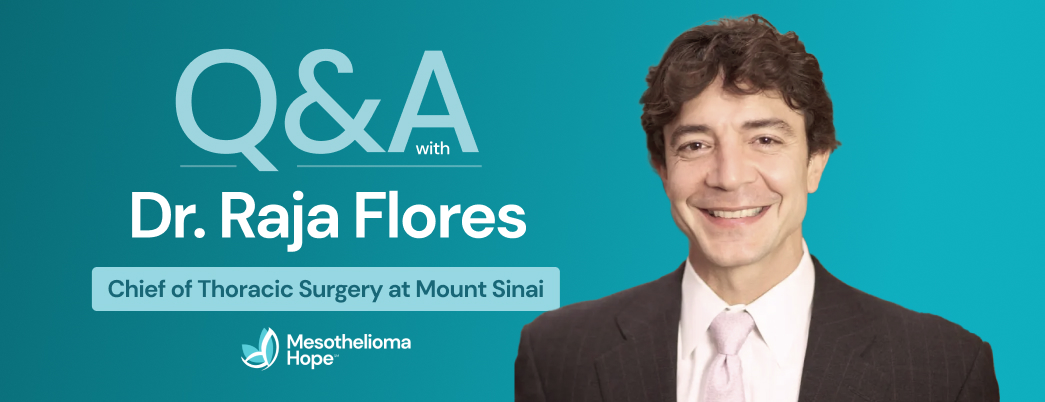
Dr. Raja Flores says that distinction is getting lost. Recent research has raised questions about whether surgery improves survival, but after 30 years of operating on patients with mesothelioma, Dr. Flores notes that the results depend heavily on choosing the right patients for surgery in the first place.
Dr. Flores is the Chairman of the Department of Thoracic Surgery at Mount Sinai Health System in New York City. In this exclusive Q&A with Mesothelioma Hope, he explains what he looks for when deciding whether a patient is a good candidate for surgery and his take on the MARS2 study for mesothelioma. He also shares what patients should know about diagnosis and finding experienced care from a specialist.
Why can mesothelioma be difficult to diagnose correctly at first?
Many of my patients come from rural areas where they were initially misdiagnosed. They go to a local place that isn’t familiar with mesothelioma; maybe they haven’t seen a case in two or three years. They see a patient with fluid in their lungs, take that fluid, and diagnose them with adenocarcinoma, which could be lung, could be breast, could be a bunch of different things.
But the behavior is a little different, and some astute doctors take note if it isn’t behaving the way a regular adenocarcinoma does. They send it out for more testing, and that’s when the patient gets identified as having mesothelioma and comes to see me.
Is a longer wait between diagnosis and treatment always a bad thing?
We did a study looking at survival in mesothelioma, and the longer the lag time from diagnosis to treatment, the better those patients did. What we found is that those patients went to specialized centers for mesothelioma. That accounted for the delay, and it reflected positively on the patient.
So it’s a little counterintuitive — you’d think if it took longer, you’d do worse, but the ones who took longer to get that initial treatment, because it was the right treatment, actually did better.
How do you know if a mesothelioma patient can safely have surgery?
Every patient should get a CT scan, which shows the anatomy, and every patient should get a PET scan, which will show if they have disease outside of their chest. If they do, they shouldn’t have surgery.
I call it the Flores five: a CT scan, a PET scan, a pulmonary function test, a cardiac stress test, and looking at the biopsy slides to make sure it really is mesothelioma, and if it is, what kind (epithelioid, mixed, or sarcomatoid). Those things tell you if a patient is a candidate for surgery.
The most important thing is that you have to have that patient in front of you, and you have to be able to feel it. I can’t quantify it, I can’t fully explain it, but I know when I have a patient in front of me whether they’re going to do well with surgery or not.
Should patients be worried by studies that say mesothelioma surgery doesn’t help?
There’s a lot of mixed information out there right now because of MARS2, a randomized controlled trial out of the United Kingdom that set out to compare surgery versus no surgery for mesothelioma.
But that’s not really what they studied. Every patient in both groups got chemotherapy first, which is a completely different scenario. We stopped giving chemotherapy before surgery for mesothelioma about 15 years ago, because patients do better with surgery first.
The trial also had a 9% mortality rate in the surgery group. There’s no treatment where that would be considered acceptable. Some of that group included patients with more advanced disease than we’d normally operate on, and everyone got the same extended version of the surgery instead of an approach tailored to their disease.
Even one of the trial’s own investigators went back and looked at the surgical patients afterward. He reviewed roughly half and said he wouldn’t have operated on two-thirds of them.
Patient selection is everything, and that’s the biggest confusion patients have about surgery right now. We still offer surgery, but it has to be the right patient, and they can do very well.
How has the shift from extrapleural pneumonectomy to pleurectomy with decortication changed care for mesothelioma patients?
We used to do extrapleural pneumonectomy — taking out the lung, the pericardium, the diaphragm, and the pleura — 50 to 100 times a year.
In 2008, I presented a study showing that shifting to pleurectomy with decortication, where you just take out the lining and spare the lung, led to much lower mortality and better outcomes, so that’s what we’ve done since.
It’s like peeling an orange — the orange is your lung, and the pleura is the covering, so you just peel the orange. It sounds simple, but it takes a lot of dissection. It’s not an elegant operation, honestly, but it’s what’s in the patient’s best interest. Patients tolerate it better because they keep the lung, and from a cancer standpoint, they’re also living longer.
What’s your view on minimally invasive surgery for mesothelioma?
You’ll see minimally invasive pleurectomy with decortication described in the literature, but that’s typically for empyema, which is an infection, not for mesothelioma.
I don’t believe that kind of surgery lets you do a good cancer operation for mesothelioma patients, because the disease covers the entire area like a sheet and gets into every little crevice. Minimally invasively, you’re leaving some of the tumor behind. So I’m not for that. We want to get everything we can find out of the body, and then we hit it with radiation therapy.
Is there an age limit for mesothelioma surgery?
Age alone won’t rule a patient out for surgery. I operated on a patient who was 97 years old. He wasn’t in the United States, but I followed him for three years and know he made it to 100.
I don’t have an age limit, but if you’re a sickly older person, surgery may not be the best thing for you. If you’re a vigorous 80-year-old, why not?
What can patients realistically expect from surgery?
One out of five patients we operate on lives 5, 8, or 10 years. Yes, the majority will die, but it’s not a death sentence.
What I tell them is, “I’m not curing you with surgery, but if you’re going to live from here to here, this surgery helps you live from here to here with a better quality of life.” I won’t use the word “cure,” but it’s been a pretty consistent 20% survival rate over time.
You studied giving an immune-stimulating drug before mesothelioma surgery. What did that trial find?
We published the results of that trial in the Journal of Thoracic and Cardiovascular Surgery. It was a small trial of about 20 patients, and it didn’t change much overall, but we showed that you can safely inject this and get a patient to surgery in two weeks, which is very different from chemotherapy. If you get three or four cycles of chemotherapy, surgery is delayed four or five months, and that allows the tumor to progress.
We had one patient with a complete response, where the whole tumor was gone when we went in for surgery, but unfortunately, it came back after a year. We were initially very encouraged, but that’s the problem with mesothelioma. We still don’t have a reliable way to identify which patients will respond like that.
What’s the next frontier in mesothelioma treatment?
Right now, we’re exploring anything we can inject directly into these tumors. I think that’s where a cure is going to come from. Immunotherapy has been hopeful, but not as good as I thought it was going to be. The preliminary trials were encouraging, but I’m not seeing those same results in my office.
I’m very pro-surgery because with surgery, you know you’re getting the tumor out. With chemotherapy or other therapies, you give the drug and get another scan to see if there’s a little shrinkage. With surgery, you go in there and get the whole thing out — that’s a complete response.
Until we get something that shows real additional time of life, I’m going to keep looking for ways to apply surgery to the right patient.
Get Help With Your Mesothelioma Care
If you have mesothelioma, you may be wondering whether surgery could be part of your treatment. As Dr. Flores explains, the answer depends on several factors, including the stage and cell type of your cancer, your heart and lung function, and your overall health.
You can talk with a mesothelioma specialist to better understand what may be appropriate for your specific diagnosis.
Mesothelioma Hope can help you:
- Request a second opinion on your diagnosis
- Find doctors experienced in surgery
- Explore clinical trials that may be available
- Access support groups and other resources
Call (866) 608-8933 or contact us online to speak with a Patient Advocate who can help you find the care and support you need.