

Women with mesothelioma tend to live longer than men, but researchers still don’t know exactly why.
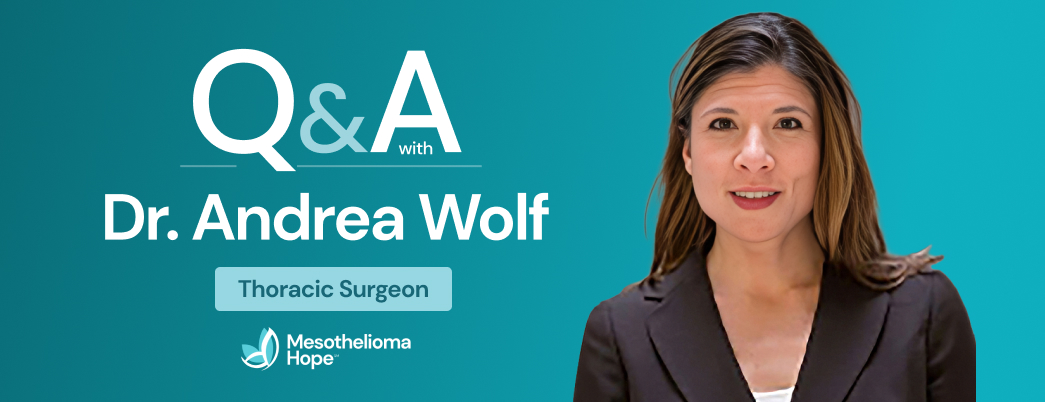
Dr. Andrea Wolf, Director of the New York Mesothelioma Program at Mount Sinai Health System, has been studying these differences and what they could eventually mean for patient care.
In this Q&A with Mesothelioma Hope, Dr. Wolf discusses her latest research on women and mesothelioma, how she chooses treatments for her patients, and how doctors can continue managing the disease if it comes back.
What did your latest research reveal about mesothelioma outcomes in men and women?
We just published some interesting things on sex differences, and this has always intrigued me in relation to women doing better than men. We studied that in a large series, including our own patients.
Because we have our own patients and samples and all of the clinical information linked to it, we’re able to tell a little more than when we do these large database studies using SEER (Surveillance, Epidemiology, and End Results) or SEER Medicare.
Most recently, we’ve been looking at these sex-specific differences in survival, in the pattern of development, and patterns of recurrence. What we found supported a lot of what we had seen before: women doing better than men.
As far as why, that’s sort of the holy grail. We don’t know yet, but if we can find a way to harness that, maybe we can benefit everyone.
Your research also linked anemia to mesothelioma survival. How do sex differences factor in?
Anemia continues to be a major prognosticator (predictive sign) for a patient’s outlook, while recognizing that anemia is defined differently for men than it is for women.
Because not everyone was taking that sex difference into account, some of the past studies looking at the relationship between blood count and survival have been murky.
Once you account for those sex differences, patients with anemia unfortunately do worse. It’s not that transfusing them will help. It’s more that the behavior and biology of the tumor coincide with compromised bone marrow function, and that seems to be a poor sign.
What could these findings mean for mesothelioma treatment overall?
I think the key is individualizing and personalizing care. People seem to be wrapping their heads around that, because that’s the way medicine is going for everything.
With immunotherapy results for advanced disease being published, people are realizing there are treatments available. We have to make sure they get to centers that can give them the right treatment, but that’s real progress. Fifteen years ago, unless someone was near a cancer center, all they heard was that there was nothing to be done.
That gives people hope, and I think hope has real value. Staying positive helps people go through with treatment and often get more out of it. The goal is to extend people’s lives with high-quality time, and I think we’re getting there.
What we lack for mesothelioma right now is the knowledge of the right biomarkers to help predict who will respond to what therapy. We’re doing better, and I think we’re making progress in that regard, but we’re not there yet.
Speaking of treatments, how do you decide which one to start with?
There is no standard order. I prefer to give the adjuvant treatments — meaning chemotherapy, immunotherapy, or radiation — after surgery. I feel patients tolerate surgery better that way, and it doesn’t compromise them the way going into surgery already weakened would.
From a general standpoint, you eliminate as much visible disease as you can with surgery first. That’s about as close to a complete response as we get. When you remove it all, it’s gone. Using the adjuvant treatments afterward works well for what I call micrometastatic disease, meaning disease that’s circulating but that we can’t actually see.
The tricky part with immunotherapy specifically is that checkpoint inhibitors work best if there’s some disease already present — so the tumor needs to still be there to stimulate those treatments. Figuring out the right order for that is something we’re still working on. Some people like to give it before surgery, some after, and some use it as its own therapy.
Does mesothelioma cell type affect which treatment you recommend?
Yes. If somebody has epithelial-type disease, which tends to be less aggressive, and they have disease in their lymph nodes, I’m giving them chemotherapy afterward.
A local therapy like radiation isn’t going to address disease that’s already traveled to the lymph nodes and is presumably ready to set up shop elsewhere. Those patients are at slightly higher risk for the disease spreading, and chemotherapy helps with that.
For patients with biphasic or sarcomatoid disease, which are more aggressive cell types, I’m more concerned about the cancer coming back in the same area. For those patients, we’re giving radiation therapy, and I’m reserving immunotherapy for if and when they have a recurrence.
There are plenty of places doing it differently, in advance of surgery instead. I don’t think it’s fair for me to say one approach is definitely better. We don’t know that yet.
Can mesothelioma still be treated if it comes back?
Yes. Step one with any first round of treatment, whether that’s surgery or one of the systemic treatments, is making sure you haven’t compromised their ability to tolerate additional therapy later.
Twenty years ago, we were more freely doing a more extensive surgery called extrapleural pneumonectomy (EPP) that compromised a patient’s ability to get more treatment if they had a recurrence. It affected their lung function, heart function, and options for radiation or additional surgery.
So not doing too much damage with that first round of treatment is key, because recurrence is the rule rather than the exception with this disease, and you want options still available.
Does a mesothelioma recurrence mean the disease is terminal?
No. It’s very important to help people understand that a recurrence isn’t a death sentence.
I have literally thousands of examples of people who’ve had a recurrence, and then we deal with it. This can go on for some of my patients for decades. The key is you just have to keep living, feel well, and live long enough for the next advances.
There are plenty of diseases that aren’t curable. I take real caution not to use the word “cure” for mesothelioma, but diabetes isn’t curable either. Neither is heart disease or coronary disease. Yet we have plenty of people functioning well and living with those diseases for decades.
I remember calling a patient years ago to check in, and his widow answered. She told me he’d passed away 15 years earlier, and I assumed the mesothelioma had caught up with him. She said no, he’d done great from the mesothelioma, and about four years after his surgery, he’d gotten into a terrible accident instead. It was hard to hear, but I thought to myself, this is actually the goal: to have people die from something else.
You recently studied a new treatment called Poly-ICLC. What did you learn from that trial?
We had some promising results in that trial, which we published in the Journal of Thoracic and Cardiovascular Surgery. It was our first clinical trial, a phase 1b trial, of a substance called Poly-ICLC, which is a vaccine that primes the immune system to target a patient’s individual tumor.
One patient had a complete response to chemotherapy after receiving the vaccine, and then ultimately had surgery. A complete response to chemotherapy by itself is something we’ve never seen with this disease, and it’s presumably because it was combined with that immune stimulant.
It’s the kind of result that’s giving people some real optimism that we’re slowly making progress with immunotherapy for mesothelioma.
What’s next for this type of treatment?
There are so many groups working on this right now. Different investigators at different institutions are looking at peptide vaccines, personalized vaccines built around a patient’s own tumor, that kind of thing. A lot of it is being investigated in mesothelioma specifically.
For us, what’s next is combining Poly-ICLC with additional therapies in our next clinical trial. We’re going to look at what survival advantages there are with that combination, and which patient populations benefit most from it.
We’re also trying various combinations of therapy and working on models so we can test combination treatments faster.
Connect With a Mesothelioma Specialist
If you or someone you love has mesothelioma, figuring out what comes next can feel like a lot. But as Dr. Wolf explains, there are more treatment options today, and finding the right care can make a big difference.
An experienced mesothelioma specialist can take the time to understand your diagnosis, talk through your treatment options, and help determine whether you can join a clinical trial.
Mesothelioma Hope is here to help you take that next step. We can connect you with experienced doctors and provide resources to support you and your family along the way.
Call (866) 608-8933 or contact us online to speak with a Patient Advocate today.